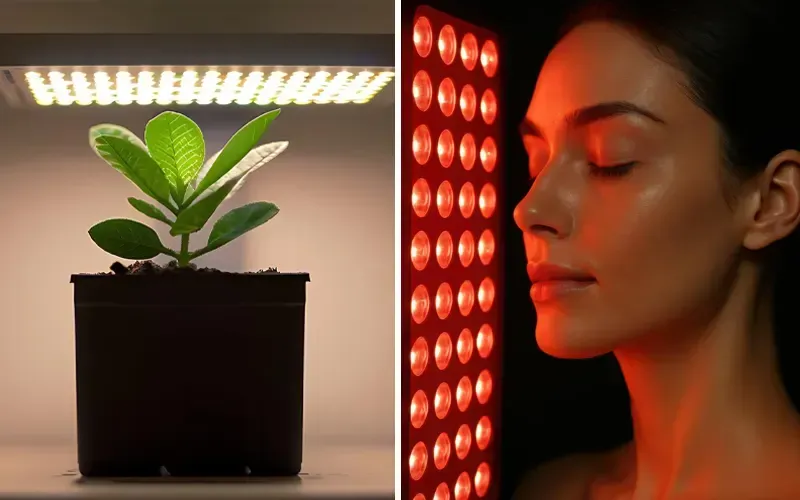


Grow lights and red light therapy devices can look surprisingly similar. Both use LEDs, may give off red light, and sometimes advertise red and near-infrared wavelengths. With cheaper grow lights available, you might wonder whether one could do the same job.
Producing red light does not automatically make a device suitable for red light therapy. What matters is the mix of wavelengths it produces, how its output is distributed, and how much light reaches your skin.
You also need to consider irradiance, or light intensity at the exposed area, and dose, the energy delivered over time. Distance, session length, and the device’s safety features help complete the picture.
This article explains where grow lights and therapy panels overlap, how they differ, and what to check before treating one as a substitute for the other.
Can You Use a Grow Light for Red Light Therapy?
Some grow lights produce wavelengths that overlap with those used in red light therapy. However, that overlap does not establish that they are safe, effective, or equivalent substitutes for a therapy device.
Photobiomodulation, the process behind red light therapy, involves exposing tissue to light under specific conditions. Research uses defined wavelengths and exposure settings. A grow light with similar red LEDs does not automatically reproduce those conditions.
For example, a controlled skin study evaluated particular light sources and treatment schedules. Its findings cannot be applied to an unrelated grow light simply because both emit red light.
The practical answer depends on the individual device. Without reliable output measurements and appropriate human-use safety information, there is too much uncertainty to treat a grow light as a predictable replacement.
Why Do Grow Lights and Red Light Therapy Panels Look Similar?
Both devices can use LED technology, which allows manufacturers to combine different wavelengths in one panel.
Grow lights containing red and blue LEDs may look pink or purple. Other models use white LEDs, sometimes with additional red LEDs, to produce a broader spectrum. The term “full spectrum” describes a lighting approach, but it does not tell you the exact amount of each wavelength.
The main difference is the intended biological target.
Grow lights provide light for plant photosynthesis and influence plant growth and development. Research on greenhouse crops, for example, tests combinations of red, blue, and far-red light for plant-specific outcomes.
Red light therapy devices are designed to expose human tissue to selected wavelengths at specified settings.
Similar-looking LEDs can therefore sit inside products with very different instructions, output patterns, and intended uses.
What Wavelengths Do Grow Lights Produce?
There is no single grow-light spectrum. Check the specifications for the exact model instead of assuming that every red or purple panel produces the same light.
Red Wavelengths
Grow lights may include red output around 620–670 nm, including LEDs advertised near 630 nm or 660 nm. Some of these wavelengths overlap with those investigated in photobiomodulation.
That overlap explains the interest in using plant lights for therapy. However, a wavelength listing does not reveal how much energy reaches your skin or establish a benefit from that particular device.
Blue Wavelengths
Blue light covers approximately 400–500 nm, with wavelengths near 450 nm appearing in some grow-light designs.
Manufacturers include blue light because it serves plant needs. Red-and-blue lighting is one established approach in indoor growing.
Blue light is not automatically harmful. Its presence does mean that part of the panel’s output serves a different purpose from red/NIR photobiomodulation.
Near-Infrared Wavelengths
Some grow lights provide little or no output in the near-infrared bands commonly used by red/NIR therapy panels.
Also, check what a manufacturer means by “infrared.” Horticultural far-red light around 730 nm does not establish that a device delivers meaningful output at 810, 830, or 850 nm.
Look for actual wavelength measurements. A broad label such as “full spectrum” cannot confirm the near-infrared output you want.
Red Light Therapy Depends on More Than Wavelength
A device may produce red light at the wavelengths you want, but that alone does not tell you whether it can deliver a useful treatment. You also need to know how much light reaches your skin, from what distance, and for how long.
Wavelength
Wavelength, measured in nanometers (nm), tells you which part of the light spectrum a device produces. Check the listed wavelengths to understand whether its output includes red light, near-infrared light, or a mix of other wavelengths.
Irradiance
Irradiance is the amount of optical power reaching each square centimeter of the exposed area. It is usually measured in mW/cm².
Check the distance at which the reading was taken. A measurement without that detail tells you little about how much light would reach your skin during use.
Dose / Fluence
Dose, also called fluence, is the energy delivered per square centimeter over a session. It is measured in J/cm².
Irradiance tells you how quickly that energy arrives. Dose tells you how much has arrived over the full exposure time.
Treatment Distance
The amount of light reaching your skin generally decreases as you move farther from the panel. Changing your position can therefore change the dose you receive, even if the session length stays the same.
Use an irradiance measurement taken at the distance you intend to use.
Treatment Time
For steady light output, the basic relationship is:
Dose = Irradiance × Time
To calculate dose in J/cm², use irradiance in W/cm² and time in seconds. Divide a reading in mW/cm² by 1,000 to convert it to W/cm².
This calculation estimates the energy reaching the exposed area; it does not tell you which dose is appropriate. Our red light therapy dosing guide explains how these measurements fit together.
Why a Grow Light’s Wattage Doesn’t Tell You Whether It Works
A grow light advertised as 100W, 200W, or 300W may sound powerful. But that number does not tell you how much red or near-infrared light reaches your skin.
First, check what the wattage means. It may describe actual electrical consumption, a comparison with another lamp, or a marketing designation.
Even actual electrical wattage leaves several questions unanswered:
- How much electricity becomes light, and how much becomes heat?
- What proportion of the light is red or near-infrared?
- How widely does the panel spread that light?
- What irradiance reaches the intended exposure area?
A higher-wattage lamp could illuminate a larger area or devote more output to other wavelengths. Neither necessarily means a higher red/NIR dose at your skin.
Electrical power is not a substitute for measured optical output.
LED Grow Light vs. Red Light Therapy Panel
| Feature | LED Grow Lights | Red Light Therapy Panels |
|---|---|---|
| Primary purpose | Plant growth and development | Human light exposure for photobiomodulation |
| Spectrum | Selected for horticultural use | Selected for intended human applications |
| Red wavelengths | May be included | Typically a central part of the design |
| NIR wavelengths | May be absent or limited | Included in many red/NIR panels |
| Blue light | Present in many designs | Device-dependent; absent from some panels |
| Irradiance information | May emphasize plant-light measurements | May provide mW/cm² at stated distances |
| Dosing guidance | Usually no human-use guidance | May include session and distance instructions |
| Timer | May follow plant-lighting schedules | May allow shorter session settings |
| Mounting | Often designed for overhead growing areas | May support positioning near the body |
| Safety information | Intended for horticultural operation | Should address the intended human exposure |
| EMF and flicker data | Availability varies | Availability and measurement quality vary |
Neither a higher price nor a therapy label proves that a panel performs well. Clear measurements and suitable instructions matter for both categories.
What Happens If a Grow Light Has Therapeutic Red Wavelengths?
Light at a particular wavelength does not change its physical properties because a manufacturer markets the device for plants.
That means a grow light could, in principle, deliver red light within a range studied for photobiomodulation. It would be inaccurate to dismiss that possibility solely because of the product category.
However, this is a physical possibility, not evidence that a particular grow light produces a useful clinical result.
You still need to establish the amount of relevant light reaching the skin, its distribution across the exposure area, and whether the proposed use is safe.
A matching wavelength answers one question. It leaves the rest of the treatment conditions unresolved.
The Problem With Blue Light in Some Grow Lights
Blue light helps serve a grow light’s horticultural purpose. For someone seeking red/NIR exposure, it adds another part of the spectrum that needs assessment.
Two separate issues matter here: eye exposure and the timing of light exposure.
Eye exposure: The International Commission on Illumination explains that retinal blue-light hazard depends on exposure conditions, including wavelength and brightness. It should not be confused with a claim that all blue light is dangerous. Ordinary lighting assessments also do not establish that staring into a grow lamp at close range is safe.
Evening exposure: Light reaching the eyes can affect circadian timing. A controlled study involving nine adults found that evening tablet use delayed bedtime, suppressed melatonin, and reduced next-morning alertness compared with reading printed materials. The study did not test grow lights, but it supports considering how evening light exposure may affect sleep.
The concern is therefore the device’s actual spectrum and exposure conditions. A visible blue component alone cannot tell you the level of risk.
Can You Calculate a Red Light Therapy Dose From a Grow Light?
You can estimate incident energy per unit area if you have reliable irradiance measurements for the relevant wavelengths at the intended distance.
The formula is:
Dose (J/cm²) = Irradiance (W/cm²) × Time (seconds)
Because specifications often use milliwatts, divide mW/cm² by 1,000 before multiplying by time.
For example:
10 mW/cm² = 0.010 W/cm²
0.010 W/cm² × 1,000 seconds = 10 J/cm²
This is an arithmetic example, not a recommended treatment dose or session length.
The main difficulty is knowing what the irradiance reading includes. A total measurement combining blue, green, red, and near-infrared light cannot be treated as red/NIR irradiance.
Other limitations also matter:
- Uneven output means different areas may receive different doses.
- Pulsed output requires the appropriate time-averaged measurement.
- Energy reaching the skin is different from energy absorbed deeper in tissue.
- A calculated dose does not establish safety or effectiveness.
Grow-light measurements such as lux or PPFD should not be inserted directly into this formula. They describe different quantities and require additional spectral information for meaningful conversion.
What Should You Check Before Using a Grow Light?
These checks help reveal missing information. Completing them does not, by itself, validate a grow light for therapy.
1. Wavelength Spectrum
Look for a spectral distribution showing which wavelengths are present. Color descriptions and LED counts are not enough.
2. Irradiance
Check for measurements at stated distances and settings, ideally across the intended exposure area.
3. Spectral Output
Find out how much measured output falls within the red and near-infrared bands of interest.
4. Blue-Light Output
Check the amount of blue light and whether it operates separately. Its contribution cannot be judged reliably from photographs.
5. Heat
Review cooling, ventilation, and clearance requirements. Warmth does not demonstrate a useful photobiomodulation dose.
6. Flicker
Look for measured flicker information. A light appearing steady to your eyes does not fully describe its output over time.
7. EMF
If electric or magnetic field measurements are provided, check the units, distance, and testing method. A standalone number without context does not establish a health risk.
8. Build Quality
Inspect the housing, wiring, mounting, and electrical safety documentation. Do not use a damaged fixture.
9. Eye Safety
Look for an assessment and instructions covering the intended exposure. Do not assume closed eyes or ordinary sunglasses provide adequate protection.
10. Dose Control
Check whether distance, intensity, and exposure time can be controlled consistently. Uncertain output cannot be fixed simply by choosing a shorter session.
Are Cheap Grow Lights a Good Alternative to Red Light Therapy Panels?
The answer depends on what the individual lamp delivers and how well that output is documented.
Scenario 1: Mostly Blue and Red Output
This is generally an awkward substitute for someone seeking controlled red/NIR exposure.
Some of the output serves other purposes, and the total irradiance does not tell you the red-light dose. Separate controls and wavelength-specific measurements would be needed to understand the exposure.
Scenario 2: Strong Red Output but Little NIR
There may be relevant wavelength overlap, but the lamp cannot reproduce a protocol requiring near-infrared light.
Missing NIR does not automatically make a device ineffective for every application. Red-only exposure has also been studied. The question is whether the device matches the intended application and its exposure requirements.
Scenario 3: Known Wavelengths and Measured Irradiance
This provides more useful information, but further assessment is still necessary.
Known optical output does not establish suitable eye safety, electrical safety, heat management, or clinical effectiveness. A low purchase price is less appealing if essential information is unavailable.
Grow Light vs. Purpose-Built Red Light Therapy Panel: Which Should You Choose?
For most home users, a well-documented device designed for human use is the more straightforward choice.
A grow light should only enter serious consideration when its spectrum, relevant irradiance, and safety characteristics are adequately understood. Calculating a dose alone is insufficient, and horticultural instructions do not establish a human treatment protocol.
A dedicated red light therapy device is more practical when you want:
- Clearly specified wavelengths and output.
- Instructions for treatment distance and session time.
- Controls suited to short, repeatable sessions.
- Mounting designed around body positioning.
- Eye-safety guidance for its intended use.
Apply those checks to therapy panels too. Avoid assuming that every dedicated device has accurate specifications or evidence supporting every advertised benefit.
Our red light therapy panel guide offers a starting point for comparing purpose-built options.
Frequently Asked Questions
Can You Use a Grow Light as a Red Light Therapy Device?
A: Some grow lights emit overlapping wavelengths, but that alone does not establish suitability. Reliable wavelength-specific output measurements and human-use safety information are needed before considering one as a substitute.
Are LED Grow Lights the Same as Red Light Therapy?
A: No. They may share LED technology, but grow lights are designed for plants. Red light therapy devices are designed around human exposure, with different instructions and intended applications.
Do Grow Lights Have Red Light Wavelengths?
A: Many do. However, the wavelengths and their contribution to total output vary. Check the individual model’s spectral data rather than relying on its visible color.
Can a 660 nm Grow Light Be Used for Red Light Therapy?
A: A 660 nm listing indicates potential wavelength overlap. It does not confirm the irradiance at your skin, an appropriate dose, or safe human use.
Do Grow Lights Produce Near-Infrared Light?
A: Some do, while others provide little or none in the bands used by many red/NIR therapy panels. Check specific wavelengths and measured output; “full spectrum” is not enough.
Is a Grow Light Safe to Use on Your Skin?
A: You cannot assume it is suitable for deliberate, repeated skin exposure. Heat, spectrum, distance, exposure duration, and eye safety need assessment for the exact device.
Can Grow Lights Replace Red Light Therapy Panels?
A: They are not interchangeable as a category. A grow light may share some optical characteristics, but replacing a therapy panel requires much more information than a matching red wavelength.
Final Verdict — Can a Grow Light Replace Red Light Therapy?
A grow light can emit red wavelengths used in photobiomodulation research. That does not automatically make it a suitable therapy device.
The decision depends on its measured spectrum, relevant irradiance, exposure control, heat, and safety characteristics. Those details are often more difficult to establish when a lamp is designed and documented for plants.
For predictable home use, a purpose-built device with reliable specifications and clear human-use instructions is generally the more straightforward option. Judge the individual product by those details, rather than its color, wattage, or price alone.