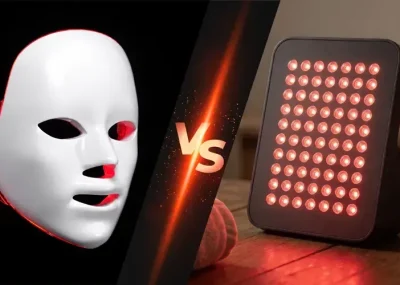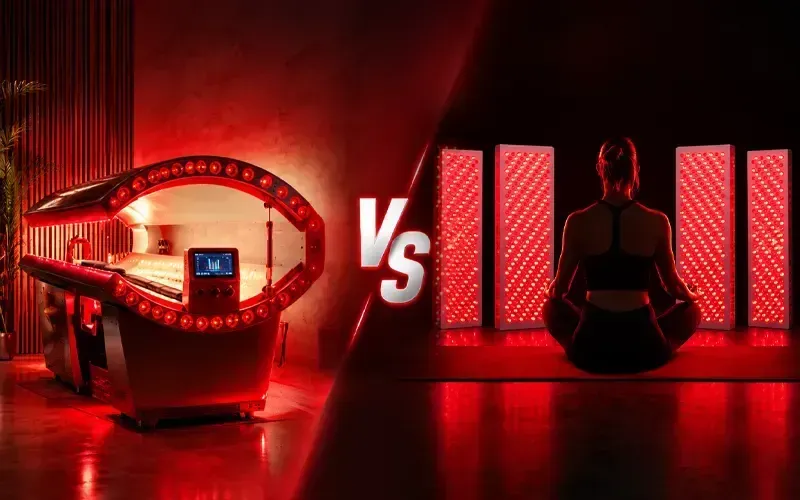


While both red light therapy beds and red light panels provide the red and near-infrared light therapy, they are entirely different devices. While lying down a bed covers your body all over. A panel is positioned in front of you and you decide which part of your body will be facing the panel.
It’s more than just an appearance. The difference between the two formats lies in their coverage, positioning, space requirements, flexibility and cost of a complete setup.
This guide compares beds and panels side by side. Neither format suits everyone. The right choice depends on your space, your budget and the areas of your body you want to focus on.
Red Light Therapy Beds vs. Panels at a Glance
Here’s a quick comparison before we look at each format in detail.
| Feature | Red Light Therapy Bed | Red Light Therapy Panel |
|---|---|---|
| Coverage | Covers the full body in most models | Depends on panel size and setup |
| Positioning | You lie down inside the bed | You face it, standing or seated |
| Space | Needs a dedicated area | Generally easier to fit into a home |
| Portability | Low | Varies by size |
| Targeted use | Less flexible | More flexible |
| Full-body setup | Its main purpose | May need a large panel or several panels |
| Cost | Often higher | Wide range |
| Setup | More permanent | Usually more adaptable |
Use this table as a starting point only. Models vary a lot within each format, so always check the specifications for the product you’re considering.
What Is a Red Light Therapy Bed?
A red light therapy bed is a large device you lie down in so that red light reaches your whole body. You lie on a lower section with rows of small lights, and a lid with more lights closes over you, similar to a tanning bed. This way, the light reaches your front and back at the same time. Some open models have lights on one side only.
The bed gives off two types of light: red light, which you can see, and near-infrared (NIR) light, which you can’t. Because the lights surround you, one session covers most of your body, and you don’t need to move.
You’ll mostly find these beds in spas, gyms and wellness clinics, though some people buy one for home.
Is a Red Light Therapy Bed the Same as a Tanning Bed?
No, not automatically. Tanning beds use ultraviolet (UV) light, which darkens the skin by increasing melanin. Red light therapy, which researchers call photobiomodulation, uses red and NIR wavelengths outside the UV range, as a 2013 review explains. However, some salons offer beds that combine UV tubes with red lamps, so check the wavelengths the manufacturer lists before you book or buy.
What Is a Red Light Therapy Panel?
A red light therapy panel is a flat device with rows of red and NIR LEDs. You face it, standing or seated, and it shines light onto whichever part of your body faces it.
Panels come in a wide range of sizes:
- Small panels suit the face or a single area, such as a knee or shoulder.
- Mid-sized panels can reach a larger area, like your back or torso, in one session.
- Full-length panels stand roughly as tall as a person and can cover much of the front or back of the body.
Depending on the model, you can fix a panel to a wall mount, hang it over a door or place it on a floor stand. Some brands also let you link several panels together to cover a bigger area.
That flexibility is the main reason panels suit home use. You can move one to another room, adjust its height or angle, and put it away between sessions. To compare specific models, see our reviews of red light therapy panels.
Red Light Therapy Bed vs. Panel: Key Differences
Beds and panels use the same types of light, so the real differences come down to how you use them day to day.
Coverage
A bed covers most of your body in a single session. You lie down, the LEDs surround you, and you rarely need to change position.
With a panel, coverage depends on its dimensions. A small panel might reach only your face or one knee, so you’d need to move it or turn around to reach other areas. A full-length panel, or several panels linked together, can cover a much larger area.
Treatment Position and Convenience
In a bed, you lie down in a space you’ve set aside for sessions. Once you’re in position, you can stay still until the timer ends.
Using a panel takes a little more effort. You position yourself in front of it, and you may need to turn halfway through to expose your back. In return, you get more control. You can angle the panel towards one area, read during a session, or change your distance within the manufacturer’s guidance.
Space Requirements
A bed needs substantial floor space, often around the size of a single bed or larger, plus room to open the lid. Most owners keep it in one permanent spot, such as a spare room or home gym.
A panel has a much smaller footprint. You can mount it on a wall, place it on a stand or, with smaller models, store it in a cupboard between sessions.
Flexibility and Targeted Use
This is where panels differ most in practice. You can point a panel at your face, shoulders, knees, back or legs by moving it or changing where you stand. A bed exposes your whole body every time, even when you only want to focus on one area.
Cost
Cost is harder to compare than it first looks. A full-body bed usually means a much larger upfront spend, often thousands of pounds.
Panels cover a far wider price range. A small panel costs much less than a bed, but a full-length panel or a multi-panel setup can also become expensive. So compare the cost of the complete setup you’d need, not one panel against one bed. Our guide to the best red light therapy panels shows how prices change with size.
Setup and Maintenance
Beyond the purchase price, think about what each format involves to install and look after.
| Factor | Bed | Panel |
|---|---|---|
| Installation | Often needs delivery, assembly and sometimes professional fitting | Usually plugs in and attaches to a mount or stand |
| Moving and storage | Hard to move once in place | Easy to move; smaller models store away |
| Cleaning | Wipe down the surfaces between users | Wipe the front and vents when dusty |
| Electrical needs | Some models need a dedicated circuit that an electrician installs | Most plug into a standard 13-amp socket |
| Cooling | Built-in fans; check the noise level | Larger panels use fans; check the noise level |
| Warranty and support | Check which parts it covers and who carries out repairs | Check LED and fan cover, plus return terms |
Red Light Therapy Bed vs. Panel for Full-Body Use
Full-body coverage is the main reason most people consider a bed. If that’s your goal, you have three options.
Bed
A bed gives you a purpose-built, full-body setup. You lie down, close the lid, and the lights reach your front and back at the same time, so you don’t need to reposition.
Large Panel
A full-length panel can cover much of one side of your body, depending on its size and how far you stand from it. You’ll usually need to turn around to expose the other side, which adds time to each session.
Multiple Panels
Linking several panels, or placing them on different sides of you, can create close to full-body coverage. This option needs more planning, though. You’ll need space for the panels, a way to mount them and enough sockets to power them.
Which Is More Convenient for Targeted Treatment?
Targeted use is almost the opposite of full-body use, and here panels have the advantage. Because you can move a panel or change where you stand, you can point the light at the one area you want to focus on. For example:
- Face: Place a small or mid-sized panel at face level, wearing any eye protection the manufacturer recommends.
- Knees and legs: Set a panel low on its stand so the light reaches your knees and legs.
- Shoulders and back: Stand with your back or side towards the panel.
- Sore areas: Some people angle a panel towards a part of the body that feels sore after exercise.
A bed can’t focus on one area. It exposes your whole body each session, even if you only want to reach your knee. That’s why the right format depends on how you plan to use the device.
Red Light Therapy Bed vs. Panel for Home Use
Your space and routine will shape which format makes more sense at home.
A Bed May Suit You If:
- You have a spare room or dedicated area with enough floor space.
- You want broad coverage in every session.
- You’d rather lie down than stand in front of a panel.
- You want a permanent full-body setup that’s ready whenever you need it.
A Panel May Suit You If:
- Your space is limited.
- You want to choose how and where you position yourself.
- You want to focus on specific areas, like your face or knees.
- You’d like to use one device on different parts of your body.
- You might add more panels later to expand your setup.
What About Red Light Therapy Blankets?
Red light therapy blankets combine features of both formats. Like a bed, they cover most of your body. Like a panel, they’re easy to move and store.
A blanket is a flexible wrap with LEDs in the fabric. You lie down and wrap it around yourself. It needs only a flat surface and a socket, then folds away.
Before buying, check the light source, because some “infrared blankets” mainly produce heat. To find one that uses red and NIR light, compare the models in our guide to red light therapy blankets.
What to Look for in a Red Light Therapy Bed or Panel
Whichever format you choose, these details help you compare products fairly.
Light Output
- Wavelengths: Look for exact figures in nanometers (nm). Red light is usually about 630–670 nm and NIR about 810–850 nm. Exact figures also let you compare a device with studies, such as this controlled trial.
- Irradiance: This tells you how strong the light is when it reaches your skin, in mW/cm². The light gets weaker as you move away, and brands test at different distances, so compare it together with distance and session time.
- Treatment area: A device’s overall size doesn’t always match the area its lights cover. Check the size of the light surface to make sure it reaches the parts of your body you want.
Features and Fit
- Controls and timer: An automatic timer ends each session for you, and separate red and NIR settings let you adjust it.
- Cooling: Large or high-output devices get warm, so built-in fans help keep the lights and electronics from overheating.
- Dimensions and setup: Check the size, weight, mounting options and power needs. Make sure your room has enough space to open a bed’s lid fully or to stand at the right distance from a panel.
Safety and Support
- Safety certifications: Look for UKCA or CE marking, which shows the manufacturer declares the product meets UK or EU safety rules, along with clear eye-safety guidance.
- Warranty: Check how long it lasts and whether it covers the lights, fans and electronics, since repairs on large devices can be expensive.
- Manufacturer’s protocol: Follow the recommended session length, distance and frequency. These figures vary, so a routine for one product may not suit another.
How to Choose Between a Red Light Therapy Bed and Panel
If you’re still deciding, find your main priority below.
| Your priority | Format to consider |
|---|---|
| Dedicated full-body setup | Bed |
| Fewer position changes | Bed |
| A dedicated treatment space | Bed |
| Flexible home setup | Panel |
| Targeting specific body areas | Panel |
| Limited floor space | Panel |
| Room to expand later | Panel |
| Full-body exposure | Bed or multiple panels |
If some of your priorities suit a bed and others suit a panel, go with the format that matches your top priority.
Frequently Asked Questions
Are red light therapy beds better than panels?
A: Neither is better overall. A bed suits people who want full-body sessions without moving, while a panel suits people who want flexibility or have limited space.
Can a red light therapy panel provide full-body coverage?
A: A full-length panel can reach one side of your body at a time, so you’ll need to turn around halfway through a session.
Are red light therapy beds safe?
A: Beds that use only red and NIR light don’t expose you to UV light. Still, follow the manufacturer’s instructions, protect your eyes as advised, and speak to your doctor first if you’re pregnant, have a health condition or take medication that increases light sensitivity.
Do red light therapy beds tan the skin?
A: A bed that uses only red and NIR light won’t tan you, because tanning comes from UV light. Some salon beds add UV tubes, though, and those can tan.
How long should you use a red light therapy bed or panel?
A: It depends on the device. Many manufacturers suggest sessions of around 10 to 20 minutes, but power output and distance change the right time, so follow the instructions for your model.
Can you use a red light therapy panel every day?
A: Some manufacturers say daily use is fine, while others suggest a few sessions a week. Check your device’s guidance, and ask your doctor if you’re unsure.
Are red light therapy panels cheaper than beds?
A: A single small panel usually costs less than a bed. A full-body panel setup can cost as much as some beds, though, so compare complete setups.
Can multiple red light therapy panels replace a bed?
A: They can come close in coverage and give you more flexibility. However, you’ll need extra space, mounting hardware and sockets, and you may still have to turn during sessions.
Are red light therapy blankets an alternative to beds?
A: They can be. A blanket covers much of your body while you lie down and folds away afterwards. Check that it uses red and NIR LEDs rather than heat alone.
Conclusion
Red light therapy beds and panels both give off red and NIR light, but they suit different needs. A bed gives you full-body sessions without changing position, though it usually costs more and needs a dedicated space. A panel takes up less room, lets you focus on specific areas, and you can add more panels later to cover more of your body.
Before you buy, compare the wavelengths, irradiance, coverage and warranty, and follow the manufacturer’s instructions. If you’re pregnant or have a health condition, speak to your doctor first.