

Overview
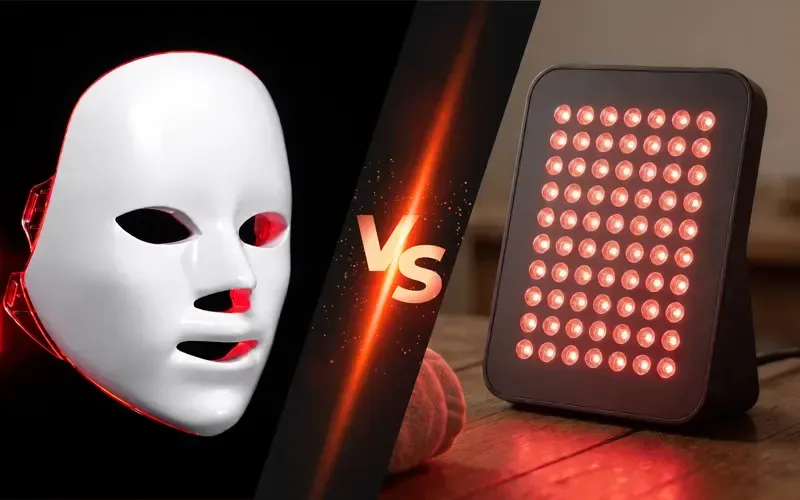
Comparing an LED mask vs red light therapy panel starts with where you want to use the light. A mask follows your face’s shape and suits a wearable facial routine, while a panel lets you direct light toward your face or other body areas for more flexible coverage. Neither design alone proves better skin results, so consider your budget, available space, and comfort when choosing. Before using either device, check the model’s instructions, light settings, and eye-safety guidance.
Quick comparison table
Numerical entries show manufacturer examples, not category averages or independent measurements.
| Feature | LED mask | Red light therapy panel |
|---|---|---|
| Best for | Face-focused routines, travel and hands-free convenience | Face plus body, stronger output and flexible use |
| Coverage | Face only, with the light sitting close to the skin. LED spacing varies by model, so coverage can be less even | Large, even coverage that can reach the face, neck, torso and limbs, depending on panel size |
| Typical power | Generally lower output, since masks are designed to sit against the skin | Generally higher output, and it changes with distance |
| Session length | Usually about 10–20 minutes, following the manufacturer’s guidance | Varies with the device and your distance from it. Typically a few minutes up to about 10–20 minutes |
| Portability | Lightweight and often cordless or battery-powered, so easy to use anywhere | Less portable, as most need a power outlet and a stand, door mount or tabletop. Compact models travel better |
| Comfort | Worn on the face, so hands-free, though straps and weight can feel restrictive | Nothing touches your skin, but you need to sit or stand at the right distance, which suits relaxed routines |
| Face-only vs body | Face only | Face and body |
| Eye safety | Most masks block or shield the eyes by design. Check the manufacturer’s eye-protection guidance | Close your eyes or wear protective goggles, and don’t stare into the LEDs |
| Price range | Typically from roughly the low hundreds of dollars up to premium models | Compact models cost about the same as mid-range masks. Full-size panels run into the high hundreds and beyond |
Speak to your doctor before use if you are pregnant, have a health condition, or take medication that increases sensitivity to light. Follow the manufacturer’s instructions and eye-safety guidance.
What is an LED mask and how does it work?
An LED mask is a wearable device that holds small lights close to your face and directs selected types of light toward your skin. Some models use flexible silicone that follows your facial shape, while others have a rigid shell. Adjustable straps help hold the mask in place. A comfortable fit should keep the eye and mouth openings aligned without putting pressure on your nose or cheeks.
Many masks use a rechargeable battery, either built into the mask or housed in a connected controller. Wavelength options vary: some combine red and near-infrared light, while others add blue or additional colors. Check each model’s intended uses and instructions. Our guide to red light therapy mask science explains the technology further.
To compare fit, controls, and light options, browse our led-face-masks-reviews.
What is a red light therapy panel?
A red light therapy panel is a set of lights that are arranged in a flat panel. You connect a standard home electrical panel to an outlet, and stand in front of the panel.You connect a standard home panel to a home outlet and stand in front of the common panel. This is supported in a stand or mounting system, thus no facial equipment is required.
There are a number of panel sizes. A compact model may point toward your cheeks, neck or selected area. The larger models have more light surface and therefore more coverage. When considering where to put one, make sure to read the dimensions and mounting instructions.
There is a space between skin and panel which is important. A change in that distance will alter the area of the light that reaches you and how intense it is to your skin. Use in accordance with the manufacturer’s instructions. To compare sizes and setup options, explore our red light therapy panels reviews.
Head-to-head comparison
Power and irradiance
Irradiance means how strong the light is over a given area at a stated distance. It differs from the electricity a device uses. Compare figures only when you know the measurement distance and method.
- Masks: Manufacturers measure output close to the face, often at contact.
- Panels: Output figures depend on the gap between the lights and your skin. Check our guide to red light therapy distance from skin before choosing your position.
A larger figure alone does not establish better skin results.
Treatment time and dose
Dose describes the light energy reaching an area during a session. Both light strength and exposure time contribute, so a longer session does not automatically improve a routine. Use the timing for your exact device and setting.
A controlled skin study compared specific red and broader-spectrum light sources with a control group. Researchers reported changes in several skin measurements, but they did not compare these consumer masks against these panels.
Light coverage and evenness
- Masks: Check how the lights line up with your forehead, cheeks, and jaw. Facial contours can affect exposure.
- Panels: Check coverage information at your intended distance, including light strength across the area.
Wavelengths (red, near-infrared, blue)
Red light appears visibly red; near-infrared light does not appear to the naked eye. Some facial devices also include blue light among their options. Different colors do not provide interchangeable settings.
A review of light therapy in skin discusses red and near-infrared light and their interactions with skin cells. It covers a range of research, rather than proving the claims of every home device. Match the manufacturer’s stated use to your concern instead of buying the most colors.
Comfort and convenience
- Masks: Check strap adjustment, nose pressure, controller placement, and cleaning instructions. A wearable design still needs a comfortable fit.
- Panels: Check fan noise, stand height, and the space you need to maintain the instructed distance. An awkward setup can make regular use inconvenient.
Face-only vs full-body versatility
A facial mask is perfect for a facial routine. Don’t assume you can move it to another location unless the directions say so.
A panel provides greater space flexibility. There are small sized models which cover selected body areas and large sized panels or connected systems which cover a larger area. This is about the size of the setup, not its overall recovery benefits.
Eye safety
Follow all eye safety guidelines of the manufacturer for its specific light setting. Be sure to use the protection it indicates; eye openings or closed eyelids do not provide adequate protection. Talk to a doctor before use if you have eye conditions, pregnancy, other health conditions or medications that make your eyes more sensitive. Stop if you experience discomfort.
Price and value
- Masks: Check the fit, controls, accessories included and replacement parts along with the price.
- Panels: Add the expense of a panel, mounting gear and accessories required.
Pay for the areas you want to operate the device in.
Durability and warranty
Review the warranty and its coverage, exclusions and process of claiming the warranty independently from the return policy. CurrentBody’s two-year warranty covers manufacturing defects, and Hooga has a three-year warranty for the HG300. Both terms are not used to measure the performance of the skin.
Ask whether coverage includes the battery, controller, power supply, and return shipping. Follow cleaning and storage directions to minimize damage that can be prevented.
Which should you choose?
Choose around your intended use and the space you have. These priorities can help you compare the two designs without assuming either one will produce a particular outcome.
| Choose a mask if | Choose a panel if |
|---|---|
| Anti-aging: Your interest centers on facial skincare and a wearable design | Anti-aging: You want to direct light toward your face and other permitted areas |
| Acne: Your doctor recommends a facial device with a suitable intended use | Acne: Your doctor recommends a device for the particular area you want to expose |
| Travel: You prefer a rechargeable facial device with protective storage | Travel: You can pack a compact panel and arrange a suitable outlet and stand |
| Budget: A mask meets your needs without separate mounting equipment | Budget: A small panel covers your intended areas at an acceptable total cost |
| Beginners: You prefer straps and preset controls | Beginners: You prefer a stationary setup and can follow distance instructions |
| Full-body recovery: You only want facial use alongside a separate recovery routine | Full-body recovery: You want broader body coverage, without assuming it guarantees recovery effects |
Can you use both?
Owning both can make practical sense if you prefer a mask for your face and a panel for another permitted area. It does not mean you need to expose the same skin twice.
Check both manuals before combining routines. One device’s session limit does not establish a combined allowance for two devices. Ask your doctor to review any overlapping use, especially when you have a health condition or take medication that increases light sensitivity.
Buy a second device only if it adds useful coverage or convenience.
How we evaluated these devices
We compared published manufacturer specifications, product listings, and warranty information. We did not conduct hands-on tests or independently measure light output.
- Design and coverage: We checked whether each device uses a wearable facial design, a compact panel, or a larger body setup.
- Published specifications: We compared disclosed light options, power figures, distances, session instructions, and accessories where manufacturers provided them.
- Ownership terms: We checked advertised warranty periods and distinguished standard coverage from extensions and money-back offers.
- Evidence limits: We kept manufacturer specifications separate from research findings. We did not use testimonials as proof of effectiveness or rank devices by promised outcomes.
The descriptions compare shopping considerations, not clinical performance.
Devices to consider
Masks
NOVAA Glow Therapy Mask
Best suited to: Comparing several light settings in a flexible facial design.
NOVAA lists red, near-infrared, blue, and yellow wavelengths, a handheld controller, and a 10-minute session. Its published standard warranty lasts one year, with an option to extend coverage. Check the instructions for your selected mode rather than assuming every color serves the same purpose.
CurrentBody Skin LED Mask
Best suited to: A facial routine with disclosed red and near-infrared specifications.
The Series 2 uses flexible silicone and a connected controller. CurrentBody lists red, near-infrared, and deeper near-infrared wavelengths, along with 10-minute sessions. Confirm the series before ordering because CurrentBody also sells newer models. Its US policy lists two-year coverage for manufacturing defects.
Glokore LED Mask
Best suited to: Comparing a wireless facial option at a lower listed price.
Glokore lists a Wireless LED Face Mask at $109.99. Check the current product manual for exact wavelengths, session settings, charging requirements, and eye protection. Ask the seller to confirm warranty coverage before ordering.
Panels
Hooga HG300: compact, face-friendly option
Best suited to: A tabletop setup for the face or another selected area.
Hooga lists red and near-infrared light, separate light switches, a built-in timer, and a foldable stand. Its $199 listing includes a three-year warranty. Follow its facial-use distance guidance rather than applying the distance associated with its headline power figure to every session.
Bestqool Pro 100: budget pick
Best suited to: A larger-area setup without the cost of a full-body upgrade.
Bestqool lists the Pro100 at $319 and describes it as a half-body panel. It costs more than the compact HG300, so consider its coverage and mounting needs when comparing value. The page advertises a two-year warranty and a warranty card for extended coverage; confirm the extension requirements.
RLT Home Total Spectrum Elite: upgrade to full body
Best suited to: A dedicated room or space for a large panel.
RLT Home lists the Elite at $4,495 with a three-year warranty and an included electric horizontal and vertical stand. This option requires more space and a much larger budget. Choose it for coverage, without assuming better facial results.
Confirm current prices, accessories, and warranty conditions before purchasing.
Common mistakes
Setup
- Wrong distance: Placing a panel closer than instructed changes exposure. Measure the gap for your intended use instead of estimating it from product photos.
- Uneven positioning: Turning away from a panel or wearing a loose mask changes where the light reaches. Adjust your setup before starting.
Expectations and precautions
- Unrealistic mask expectations: Do not expect a facial mask to provide body coverage or reproduce every result from a clinic study.
- Skipping eye protection: Follow the model’s eye-safety instructions and use the protection it requires. Ask a doctor about personal risks before use.
- Adding extra time: Follow the recommended session length. Do not combine settings or repeat sessions to pursue faster changes.
FAQs
Are masks as effective as panels?
A: Neither category automatically wins. You need evidence for the specific device, intended use, and routine. A panel’s higher published output does not prove better skin results, and a mask’s close fit does not guarantee equal exposure across your face.
Can I use a panel on my face?
A: Only if the manufacturer permits facial use. Follow its facial settings, session length, and eye-safety instructions. Speak to your doctor if you have an eye condition or other relevant health concerns.
How far should I sit?
A: Use the distance in your model’s instructions for facial use. Do not copy a distance from a different panel or from a power measurement alone. Make sure your stand lets you maintain that gap comfortably throughout the session.
Can I use both on the same day?
A: Do not assume two separate manuals authorize combined exposure on the same area. Check with the manufacturers and your doctor before combining routines. Using devices in different permitted areas still requires you to follow each device’s instructions.
Are masks safe for eyes?
A: Do not assume every mask suits every person. Follow the model’s eye-protection guidance, and ask a doctor about eye conditions or medication that increases light sensitivity. Stop use if you experience eye discomfort. Eye openings alone do not establish safety.
Do I need near-infrared?
A: Not automatically. Choose a device around its intended use and supporting evidence. An additional wavelength does not prove that a model will suit your skin better. Ask your doctor which options make sense for your concern.
How long until results?
A: No reliable time frame applies to every reader or device. Research uses specific equipment, settings, and assessment methods, which may differ from your home routine. Follow the instructions without extending exposure to pursue faster changes, and discuss persistent skin concerns with your doctor.
Conclusion
Choose an LED mask when you want a wearable facial routine. Choose a panel when you want flexible placement or broader coverage. Neither design alone establishes better skin results. Before buying, compare intended uses, fit, light settings, distance instructions, eye protection, total cost, and warranty terms.
Choose a setup you can use comfortably and follow its instructions. Speak to your doctor before use, especially during pregnancy, with health conditions, or when taking medication that increases light sensitivity.