


How Red Light Therapy Works on Skin
Red light therapy goes by a few names – low-level laser therapy, photobiomodulation, sometimes just “LED therapy” – but it’s all the same idea: specific wavelengths of light, aimed at skin, for a therapeutic effect rather than a cosmetic one. “Red light penetrates deeply into the skin layers, where it is absorbed by the skin cells and converted into energy,” says Nina Desai, a board-certified dermatologist in Manhattan, California. That energy is what does the work – it helps skin cells function better, speeds up repair of damaged cells, and nudges the skin toward producing new ones.
Jared Jagdeo, MD, founding director of the Center for Photomedicine in New York, explains the mechanism this way: “Red light waves stimulate the mitochondria, which is the energy center within each cell. We believe that sets off a cascade of changes within the cell that allows for the different benefits that we’re able to see, such as the upregulation of collagen production and the reduction of inflammation, pigmentation, and redness in the skin.”
Diane Madfes, FAAD, MD, an assistant professor of dermatology at Mount Sinai School of Medicine, has seen it work on several fronts at once – she says it can decrease inflammation, increase circulation, and help with hyperpigmentation, acne, and psoriasis. She also points out that LEDs help boost collagen production, which is really what’s behind the “smoother, less wrinkled” claims you see everywhere.
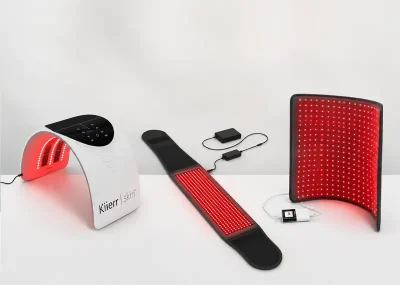
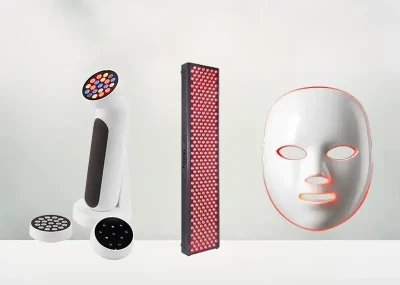
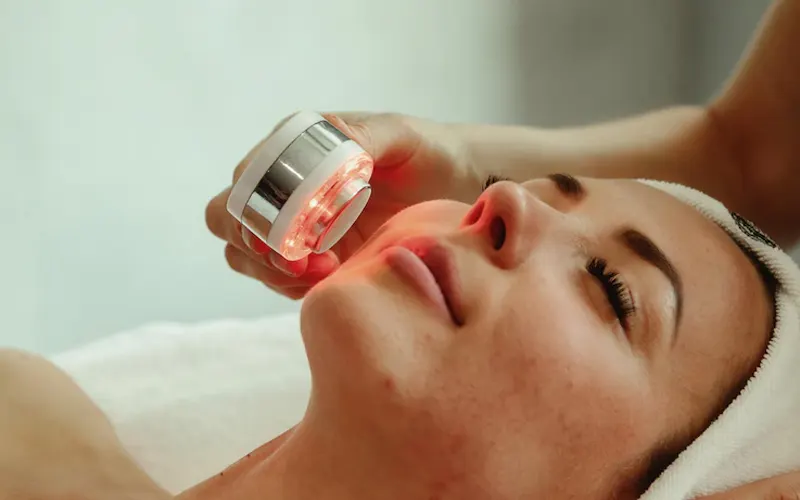
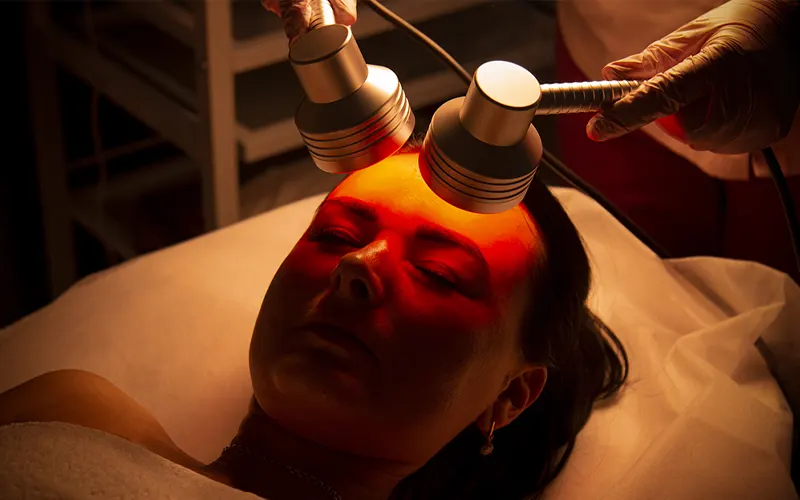
What this looks like in practice is fairly unglamorous: a light panel, face mask, or wand held a few inches from your skin for 10 to 20 minutes. Not a dramatic in-office procedure – more like a habit you build into your routine. Research published in BMJ Open Journal backs up the facial-treatment side of this, finding LEDs effective at reversing signs of aging and softening wrinkles.
Dr. Nazanin Saedi MD, a clinical associate professor at Thomas Jefferson University and board-certified dermatologist says that the biggest benefit one can get from using red light therapy is reduced inflammation.
Advertisement
*All individuals are unique. Your results can and will vary.
Experts Take on Red Light Therapy for Skin Treatment
Jared Jagdeo, MD and founding director of the center of Photomedicine in New York says, “Red light waves stimulate the mitochondria, which is the energy center within each cell. We believe that sets off a cascade of changes within the cell that allows for the different benefits that we’re able to see, such as the upregulation of collagen production and the reduction of inflammation, pigmentation, and redness in the skin.” He further explains that through his research, he has found that red light therapy has helped stimulate cellular repair, boost collagen production, support a vibrant complexion, and promote healthy-looking skin.
Red light therapy may be used to treat actinic keratosis. Angela Lamb, MD an associate professor of dermatology at Mount Sinai explains that red light therapy may be used together with photodynamic therapy. This is where the skin is applied with a photosensitizer before treatment. Topical application of photosensitizers, including lotions and creams, allows better absorption of red light therapy into the skin. It allows red light to have a better effect on the skin without any harmful effects.
The benefits you get from using light therapy are endless, including reduced wrinkles, age spots, scars, and improved skin radiance. The tools available on the market are many and they may help with treating your face or the entire body.
Red light therapy has demonstrated efficacy in addressing a range of skin concerns, including acne, collagen production, anti-aging, rosacea, and eczema. Dr Laura Geige, MD, Cosmetic Dermatologist sopke with us, She explains by stimulating collagen synthesis and promoting cellular regeneration, it helps diminish the appearance of fine lines and wrinkles, resulting in firmer, more youthful-looking skin. Moreover, its anti-inflammatory properties make it effective in reducing acne lesions and calming redness associated with rosacea. While it may not completely eliminate these conditions, incorporating red light therapy into your skincare routine can significantly improve their appearance and manage symptoms over time.
Introducing an informative video series, Dr. Aaron Farberg, MD, discusses the latest development in medical and esthetic dermatology – red light therapy. Regarded as a new intervention tool, RLT has been applauded for numerous benefits across a wide variety of fields, including wound healing, skin regeneration and rejuvenation. Dr. Farberg discusses how photodynamic therapy (PDT) when used with red light aims to improve treatment results, making it a useful option for patients who want gentle treatments for skin issues.
Key Benefits of Red Light Therapy:
- Wound Healing: Red light therapy enhances the rate of tissue regeneration and decreases inflammation, and for that reason it is ideal to apply on individuals with skin injuries or surgeries.
- Aesthetic Dermatology: For fine lines to skin texture RLT has been proven to have a safe natural way to rejuvenate skin without invasive procedures.
- Non-Invasive Treatment: As Dr. Farberg pointed out, RLT is a safe treatment option with few, if any, side effects so it should be suitable for most patients.
In this series, you will get a breakdown of the concept and research associated with red light therapy and its widening role in dermatology.
To watch Dr. Aaron Farberg’s expert insights, visit Dermatology Times. Special thanks to Dermatology Times for providing this valuable resource.
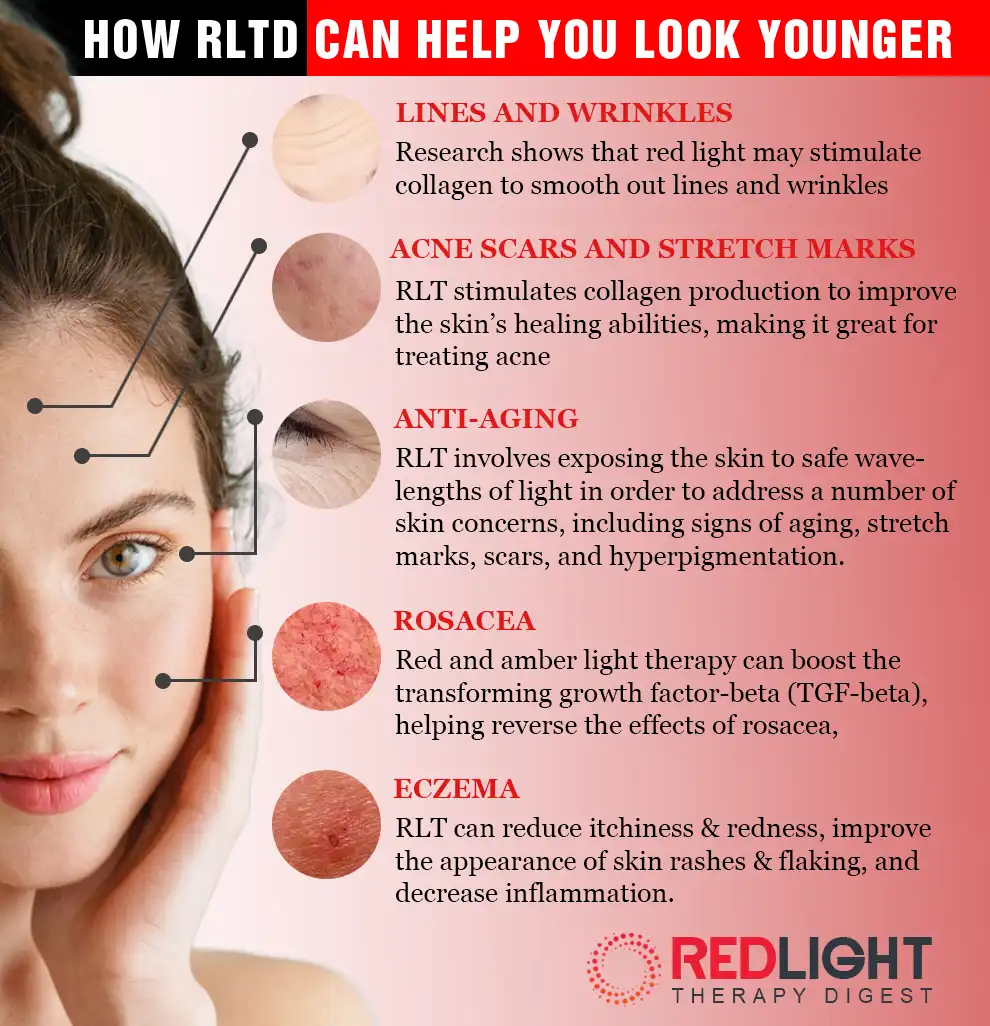 Benefits of Red Light for skin
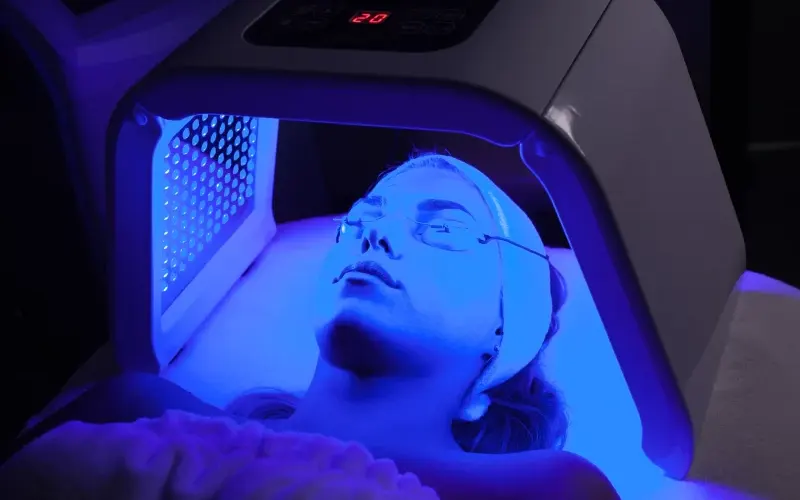
Blue light may also be used in combination with red light because its antibacterial properties are effective in the treatment of acne breakouts. LED Light therapy machines may be applied in different forms to treat various skin conditions. According to the Journal of Biophotonics published in 2019, light emitting diodes red light therapy is safe and effective in the treatment of acne vulgaris, wounds, hair growth, skin cancers, and skin lesions, and promotes skin rejuvenation.
We spoke with Anna Peterson, a Beauty & Wellness Professional, she claims red light therapy stands as a versatile ally against common skin concerns. Its efficacy extends to mitigating acne by reducing inflammation, stimulating collagen to combat signs of aging, soothing rosacea flare-ups, and providing relief for conditions like eczema. It’s a holistic approach that fortifies the skin from within, paving the way for a healthier complexion.
Recent research update: A 2024 narrative review in the International Journal of Molecular Sciences examined six years of clinical trial data on photobiomodulation in dermatology and concluded it shows promise for skin rejuvenation, wound healing, and scar management -while noting that treatment protocols still vary widely across studies and are not yet standardized.
If you are ready to get started, check out what products provide optimal benefits.
Red Light Therapy Dosage and Frequency: How Much Is Actually Needed
Here’s the part most articles on this topic skip entirely, and it’s arguably the most important one – because it’s the difference between a device that works and one that just sits on a shelf. Dosage in phototherapy is expressed in joules per square centimeter (J/cm²), which is just the light’s intensity multiplied by how long you sit under it.
For skin, that generally breaks down to a red wavelength around 630–660nm, sometimes paired with 810–850nm near-infrared for deeper reach. The doses that show up again and again in skin-focused studies sit in the 5–15 J/cm² range – noticeably lower than the 30+ J/cm² doses used for deeper tissue like muscle or joints, so more isn’t automatically better here. Most at-home panels get you there in 10 to 20 minutes, held 6 to 12 inches away – and distance matters more than people assume. Doubling that distance from 6 to 12 inches can cut the light’s actual intensity by roughly 75%, so “close enough” really isn’t.
On frequency, 3 to 5 sessions a week is the range that keeps coming up in both clinical protocols and dermatologist guidance. And on patience: Dr. Rachel Reynolds, interim chair of dermatology at Beth Israel Deaconess Medical Center, told Harvard Health that consistent use for four to six months is what it actually takes to see results. “It’s slow and steady,” she says. “It’s not going to be anyone’s quick fix.”
How to Track Your Own Results at Home
One reason red light therapy reviews online are so inconsistent is that most people never set up a real way to judge whether it’s working – they just use the device for a while and go on vibes. A simple tracking routine fixes that, and it’s what we’d recommend before you trust (or dismiss) any device based on a few weeks of use:
- Lock the variables first. Same wavelength, same distance (measure it – don’t eyeball it), same session length, same weekly frequency for the full stretch. If you change moisturizers or add a retinoid halfway through, you won’t know what actually caused any change you see.
- Photograph under consistent light. Same spot, same time of day, same camera settings if possible – natural window light works better than flash for catching texture changes. Weekly is enough; daily photos mostly just show you skin’s normal day-to-day variation.
- Give it 8 weeks before judging anything. Per the timelines above, structural changes like collagen and fine lines are a slow build – a device that “isn’t doing anything” at week 2 is on schedule, not necessarily a dud.
- Note irritation immediately, not results. Redness, tightness, or breakouts in the first week or two are worth writing down right away, since that’s the signal to lower frequency or distance – waiting until week 8 to notice a pattern means you’ve had a bad reaction for two months.
MOST POPULAR IN SKINCARE
Skin Concerns Red Light Therapy Has Been Studied For
| Concern | What the research shows |
|---|---|
| Fine lines & wrinkles | A 2023 clinical study in Skin Research and Technology put 20 women on a twice-weekly LED face mask (630nm) for three months and tracked steady gains in elasticity, density, roughness, and pore size – effects that were still visible a month after they stopped using it. |
| Acne | The Indian Dermatology Online Journal found light-based therapy cuts down inflammatory acne and scarring. Blue light often gets paired in here too, since it targets the acne-causing bacteria red light doesn’t touch. |
| Rosacea | Dermatologists point to red light’s anti-inflammatory effect for calming flare-ups and redness; amber/red combinations show up often in rosacea-specific devices. |
| Eczema & psoriasis | The Journal of Lasers in Medical Sciences notes phototherapy’s track record with moderate-to-severe psoriatic lesions, and a National Library of Medicine publication covers atopic dermatitis responding to phototherapy used alongside topical treatment – not instead of it. |
| Scarring & wound healing | A National Library of Medicine study found infrared wavelengths held up for treating acne and its scarring, largely by supporting tissue repair. |
| Collagen & elasticity | One of the more convincing setups here: researchers in the Journal of Photochemistry and Photobiology treated one side of a subject’s face with red light and the other with a placebo light, twice a week for four weeks. The treated side came out with better wrinkles, elasticity, hydration, and thicker collagen – a within-person comparison, which is a stronger design than most studies in this space. |
Worth a dose of honesty here: a 2024 narrative review in the International Journal of Molecular Sciences looked back at six years of clinical trial data on photobiomodulation in dermatology. The conclusion was cautiously positive – promising for rejuvenation, wound healing, and scar management – but it flagged that protocols across studies are still all over the map and haven’t been standardized. That’s the honest state of the science, not a reason to dismiss it.
Potential Risks and Side Effects
The reassuring baseline first: red light therapy is generally considered safe for short-term use, and unlike UV light – which we know causes skin cancer – nothing in the research links red light therapy to cancer risk. That said, a few things are worth knowing going in.
Temporary redness, mild pain, or irritation shows up in some users. Dr. Jared Jagdeo led a pair of randomized controlled trials in 2020, published in the Journal of Biophotonics, and found these effects stayed mild at standard treatment intensities, with no serious adverse events reported. Blistering and prolonged redness only turned up at very high, non-typical doses – which is a good argument for sticking to the dosage guidance above rather than assuming a stronger setting works faster.
If you’re on medication or have a photosensitive condition, that’s worth a conversation with your provider first – the AAD flags conditions like lupus as one’s light exposure can aggravate, and some medications (certain antibiotics among them) raise skin’s sensitivity to light on their own. Pregnancy is another gray area: there isn’t much safety research specific to pregnant users, so checking with an OB-GYN or dermatologist before starting is the safer call.
Two more practical notes. First, eye protection isn’t optional – use whatever goggles or shields came with the device, and don’t swap in regular sunglasses. Second, device quality genuinely varies: wavelength accuracy, real irradiance, and build quality differ a lot between at-home options, and that variance shows up in both results and safety. An FDA-cleared device from a real manufacturer is still the clearest signal you have as a buyer.
And if anything crosses the line from mild, temporary redness into blistering, peeling, or irritation that sticks around – stop and see a dermatologist.
A Note for Darker Skin Tones
This doesn’t get enough attention in most red light therapy content, so it’s earned its own section here. The American Academy of Dermatology notes that people with darker skin tones are more sensitive to visible light – red light included – than people with lighter skin. That heightened sensitivity can trigger hyperpigmentation, and the resulting dark spots tend to be more intense and slower to fade than the ones you’d get from sun exposure.
Harvard Health’s Dr. Rachel Reynolds backs this up: her advice for darker skin is to check in with a dermatologist before starting an at-home device, and to start at a lower dose rather than following whatever schedule came printed on the box. None of this rules red light therapy out – it just means starting more conservatively, and ideally with professional input, at least at the outset.
Red Light Therapy vs. Microneedling vs. Laser Therapy
| Red Light Therapy | Microneedling | Laser Therapy | |
|---|---|---|---|
| Invasiveness | Non-invasive | Invasive (micro-injuries via needles) | Invasive (concentrated heat/light) |
| Downtime | None | Temporary redness, swelling | Redness, possible peeling |
| Cost per session | Free after device purchase (at-home) or $$ in-office | ~$100–$700 per session, per Dermapen’s cost estimates; usually 4–6 sessions | Higher cost, fewer sessions needed |
| Best for | Sensitive skin, gradual maintenance, general rejuvenation | Deeper scarring, stretch marks, faster collagen response | Targeted, more dramatic resurfacing |
| Darker skin tones | Usable with caution (see below) | Generally lower pigmentation risk than laser | Higher pigmentation risk |
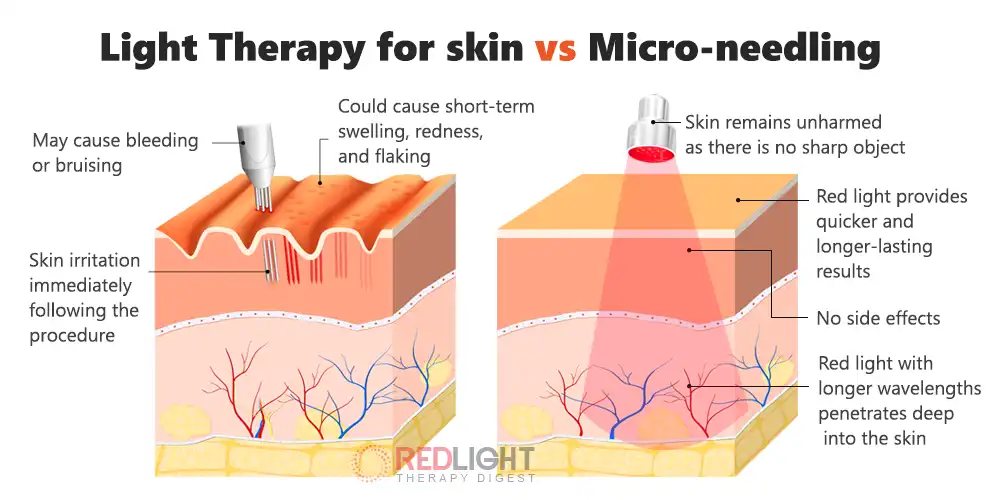
Dr Laura Geige, MD, a cosmetic dermatologist, breaks down the distinction well: laser therapy works with concentrated beams aimed at specific concerns, while red light therapy uses low-level wavelengths that get deeper into the skin without doing damage in the process. Microneedling, meanwhile, is doing something different again – controlled micro-injuries that force the skin into a collagen response. Red light gets you a comparable outcome without any of the injury, which is really why it’s the pick for sensitive skin.
How to Choose a Safe At-Home Device
“FDA-cleared” on the listing is the single clearest safety signal you’ll find as a shopper, so start there. Beyond that, dig into what wavelength the device is actually emitting – 630–660nm for red, 810–850nm for near-infrared – rather than taking “clinical-grade” at face value; that phrase means almost nothing on its own. It’s also worth checking the irradiance (mW/cm²) at the distance you’ll actually be using the device, not just at the LED surface, since real-world output tends to run lower than the number on the box once you factor in distance. And if you’re treating something a dermatologist has actually diagnosed rather than doing general maintenance, keep in mind that in-office devices tend to offer tighter dose control than anything you’ll buy for home use.
What We Still Don’t Know
Red light therapy has real, published research behind it – but it’s worth being upfront about where the science currently stands. The American Academy of Dermatology, reviewing this same body of research, points out that because researchers use different devices, different treatment lengths, and different study designs, results from one study don’t translate cleanly to another. There’s a real list of open questions dermatologists are still chasing: how long red light can safely be used, the right number of treatments for a given concern, and the most effective home-use dose.
Dr. Reynolds put it plainly to Harvard Health: “It’s not a miracle fix.” None of this means red light therapy doesn’t work – the evidence for reduced inflammation, better collagen production, and improved wound healing is real. It just means results vary by device, protocol, and person, and any claim of dramatic, fast, or guaranteed results deserves a raised eyebrow.
FAQs
Q: How often can you use red light therapy on your skin?
Q: How long does it take to see results on the face?
Q: Should you apply red light therapy directly on bare skin?
Q: What happens if you use red light therapy every day?
Q: Are at-home devices safe?
Q: Is red light therapy safe for all skin types?
Q: Can red light therapy be used for skin cancer?
Q: Can red light therapy cause skin rash or irritation?
The Bottom Line
Red light therapy has legitimate clinical research behind it for skin rejuvenation, acne, and inflammation – but it works on a schedule, not a switch. Consistency (3–5x a week), the right distance and wavelength, and realistic expectations (8 weeks minimum, longer for real change) matter more than whatever a device’s marketing page promises. If you’re managing something a dermatologist has diagnosed, loop them in before you start. If you’re just after general maintenance, an FDA-cleared at-home device used correctly is a reasonable, low-risk thing to add to a routine – just don’t expect it to move fast.