

 Fact Checked

Editor's Rating
Mito Red MitoPRO 300 X
Introduction
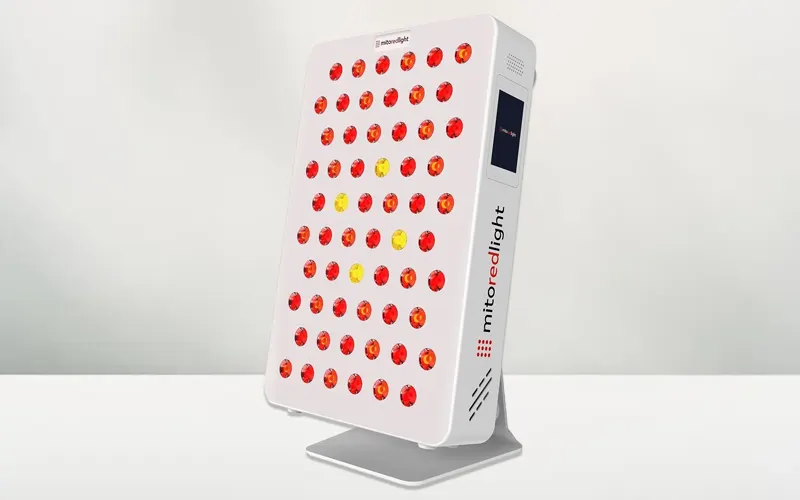
Red light therapy panels offer a convenient way to use targeted light treatments at home. The Mito Red MitoPRO 300 X is the smallest panel in the MitoPRO X series. It is made for the face, neck, joints, and other smaller treatment areas rather than full-body use. The panel combines visible red light with invisible near-infrared light in a compact tabletop design.
Compared with larger wall-mounted or full-body panels, it takes up less room and is easier to move. However, its smaller light area also means that users may need to change positions when treating several parts of the body.
This Mito Red MitoPRO 300 X review looks at its features, published test data, ease of use, specifications, possible benefits, drawbacks, customer feedback, and alternatives.
What Is the Mito Red MitoPRO 300 X?
The MitoPRO X series is Mito Red Light’s home-panel range, with models designed for different treatment areas. The 300 X is the smallest option, measuring 9.5 by 14.5 inches and weighing 7 pounds.
It is intended for targeted use on the face, neck, shoulders, knees, and other small areas. Its included tabletop stand allows it to sit on a desk or counter. Unlike larger models, it is mainly designed as a standalone panel and does not provide upper- or full-body coverage in one position.
How Does the Mito Red MitoPRO 300 X Rate?
Mito Red MitoPRO 300 X
 3.3/5Quality
 3.5/5User Friendly
 3.4/5Value
 3.5/5Customer Satisfaction
Pros
- Uses six red, amber, and near-infrared wavelengths
- Offers red, NIR, and combined light modes
- Comes with a three-year warranty and 60-day guarantee
Cons
- Too small for full-body use in one position
- Costs more than some basic two-wavelength panels
- Large areas require repeated repositioning
- Bluetooth pairing may require extra setup
- Does not include a handheld remote
- Some claims are broader than device-specific evidence
About Mito Red Light
Mito Red Light is a Scottsdale, Arizona-based company focused on red and near-infrared light products. Its range includes targeted panels, full-body panels, portable devices, masks, belts, pods, and related accessories.
The MitoPRO X line is positioned above the simpler Original 2.0 and MitoPRO+ ranges. It adds six wavelengths, a touchscreen, app control, brightness adjustment, and more control modes. The brand currently lists the MitoPRO X panels with a three-year warranty and a 60-day return period.
How Does the Mito Red MitoPRO 300 X Work?
Red and near-infrared LEDs deliver light to the treatment area. This process, called photobiomodulation (PBM), may affect cell signaling, mitochondrial activity, and blood flow. However, results depend on the wavelength, dose, distance, and treatment time, so general PBM research does not confirm the same outcomes for this device.
Red Light
The visible side of the panel uses 590 nm amber light and 630 nm and 660 nm red light. Visible red light is often used in studies involving the skin because it is absorbed closer to the surface than near-infrared light.
Near-Infrared Light
The panel’s 810, 830, and 850 nm wavelengths are near-infrared and cannot be seen by the eye. Near-infrared light can reach deeper than visible red light, although the exact depth varies. These wavelengths appear in research on muscles, joints, exercise recovery, pain, nerves, and other areas.
Light Dose and Treatment Variables
The delivered dose is not determined by panel power alone. Irradiance describes the amount of light reaching a given area. Moving farther from the panel normally lowers that amount while widening the coverage.
Treatment time and frequency also affect the total exposure. Longer or stronger sessions may not provide better results.
Scientific Evidence Behind Red and Near-Infrared Light Therapy
Skin Health and Appearance
Skin research is one of the better-studied areas of PBM. In a controlled trial, repeated red and near-infrared treatments improved measured skin roughness and collagen density compared with an untreated control.
Pain and Musculoskeletal Applications
Research has examined PBM for knee pain, osteoarthritis, low-back pain, tendons, and other muscle or joint concerns. A study published in PubMed found evidence of lower pain in some common musculoskeletal conditions, but results varied by condition and study design. It did not support PBM for every type of pain.
Pain and Musculoskeletal Applications
Photobiomodulation has been studied for joint pain and related movement problems. A systematic review and meta-analysis found that low-level light therapy reduced pain and disability in people with knee osteoarthritis. However, results depend on the light dose and treatment method, so these findings do not confirm that every device will provide the same benefits.
Other Areas Being Studied
PBM is also being studied for wound care, hair growth, brain health, sleep, and nerve-related uses. Much of this research uses purpose-built devices or clinical treatment plans. These early or mixed findings should not be transferred directly to a home panel without considering wavelength, dose, placement, and medical guidance.
Key Features of the Mito Red MitoPRO 300 X
Multi-Wavelength Light Configuration
The panel uses six wavelengths: 590, 630, 660, 810, 830, and 850 nm. The listed distribution is about 6%, 22%, 22%, 17%, 17%, and 17%. You can use the red and near-infrared channels separately or together.
Compact Targeted Treatment Design
The panel measures 9.5 by 14.5 inches, stands about 20 inches tall with its stand, and weighs 7 pounds. It suits the face, neck, arms, joints, and other small areas rather than full-body coverage.
Irradiance and Light Output
- Manufacturer-stated output: More than 130 mW/cm² with a solar meter or 56 mW/cm² with a spectroradiometer at six inches.
- Independent testing: A September 2025 LightLab report recorded 38.2 mW/cm² average irradiance, 55.9 mW/cm² peak irradiance, and 36.4 W total radiant power at six inches. An outside reviewer measured 51.8 mW/cm² average irradiance and 60 mW/cm² peak irradiance.
Adjustable Controls
The touchscreen controls session time, brightness, and light modes. Users can select red/amber, near-infrared, or combined light. The Bluetooth app adds session tracking, alarms, and extra modes, but basic controls remain available on the panel.
Pulsing Features
An outside reviewer reported a 10 Hz near-infrared pulsing mode. The current product page does not list a complete frequency range, so users should confirm this feature in the latest manual. Pulsed light is not proven to be better than continuous light.
Build Quality and Cooling
The panel has a metal housing, built-in tabletop stand, touchscreen, and rear cooling fans. Active cooling helps control heat. An outside reviewer measured about 41 dB at six inches, suggesting noticeable but fairly quiet fan noise.
First-Hand Testing Experience
First-Hand Testing Experience
Setup and Initial Impressions
The panel arrives with the power cable, manual, two types of eye protection, and a pre-installed tabletop stand, so there’s no assembly required – just set it on a stable surface and plug it in. At around 7 pounds, it’s light enough to reposition between rooms, though it’s worth noting there’s no door-hanging kit included if you were hoping to mount it.
Design and Build Quality
The metal housing and matching stand give it a clean, well-built feel, and having the stand built in rather than sold separately saves a step compared to panels that need their own tripod or mount. It’s a compact unit, but with the stand attached, total height comes in around 20 inches – worth factoring in if you’re planning where to place it.
Controls and Ease of Use
A touchscreen handles the basics – timer, brightness, and switching between red, near-infrared, or combined modes – so day-to-day use doesn’t require the companion app at all. The app is there if you want session tracking or finer control, though some users have flagged occasional pairing hiccups with it.
Treatment Coverage
The panel size suits face, neck, one shoulder, arms, knees, and other targeted spots comfortably. For larger areas – full back, both legs, or several muscle groups in one go – you’ll need to reposition partway through, which stretches out the session length.
Comfort Considerations
Like most panels in this class, the cooling fan produces some background noise during use, and overall comfort will depend on room temperature, how close you sit to the panel, and how long your session runs.
Mito Red MitoPRO 300 X Quick Facts
| Product | Mito Red MitoPRO 300 X. |
|---|---|
| Brand | brand is Mito Red Light. |
| Type | targeted red light therapy panel. |
| Best For | targeted treatment and smaller body areas. |
| Warranty | three-year warranty. |
| Trial/Return Policy | 60-day money-back period; review the current return terms before purchase. |
| Price | $449 at the time of writing. |
Specifications
| LEDs | 60 lens packages / 120 chips |
|---|---|
| LED Type | TruDUAL dual-chip LEDs |
| Wavelengths | 590, 630, 660, 810, 830, and 850 nm |
| Dimensions | 9.5 × 14.5 inches; about 20 inches tall with stand |
| Weight | 7 lb |
| Power Consumption | Manufacturer lists 125 W; accredited test recorded 111.8 W wall draw |
| Irradiance | Lab: 38.2 mW/cm² average and 55.9 mW/cm² peak at 6 inches |
| Beam Angle | Not clearly stated on the current official page |
| Treatment Area | Targeted areas such as face, neck, joints, and local muscles |
| Timer | Onboard session timer; 10-minute sessions are commonly listed |
| Brightness Control | Yes |
| Red/NIR Controls | Red/amber only, NIR only, or combined |
| Pulsing | Outside reviewer reports 10 Hz NIR pulsing; confirm in current manual |
| EMF | Manufacturer says no detectable EMF at 6+ inches; outside review reported low readings |
| Cooling System | Rear active-cooling fans; exact fan count not clearly stated |
| Rated Lifespan | Not clearly stated on the current official page |
Mito Red MitoPRO 300 X Benefits
These benefits reflect practical design advantages, not guaranteed medical results.
May Support Skin-Focused Treatments
Its compact size makes it easy to position near the face, neck, and other small areas, while adjustable brightness may improve session comfort
May Support Muscle Recovery
After exercise, users can position the panel near one targeted muscle area, such as the shoulder, arm, thigh, or calf
May Be Useful for Joint and Localized Areas
The tabletop stand helps users aim the panel at a knee, elbow, hand, or shoulder without needing a larger fixed setup
Convenient for Home Use
Its compact footprint and 7-pound weight make the panel easy to place on a desk or counter, move between rooms, and store
Offers Session Customization
Users can adjust brightness, session time, and red, near-infrared, or combined light modes. The app also provides tracking, alarms, and extra modes
How to Use the Mito Red MitoPRO 300 X
Follow these steps to position the panel and adjust each session safely.
- Place the panel and stand on a flat, stable surface with open space around the cooling vents.
- Expose the intended area and remove anything that blocks the light.
- Select red/amber, near-infrared, or combined mode on the touchscreen.
- Position the treatment area at the distance stated in the latest manual. The current FAQ recommends 12–18 inches.
- Set the session time. Mito Red commonly suggests 10 minutes for Modes 1 and 2. Onboard NIR-only Mode 3 is limited to five minutes; longer NIR operation requires the app’s NIR Extend mode.
- Start the session without staring into the LEDs. Use the included eye protection when directed or when the light feels uncomfortable.
- Follow the manufacturer’s schedule rather than increasing the time to chase faster results.
Adjust the brightness if the full setting feels uncomfortable.
Safety, Side Effects and Precautions
The bright light may cause eye discomfort, warmth, temporary redness, headaches, or irritation. Avoid staring into the LEDs and use the included eye protection as directed.
Consult a healthcare professional before use if you have an eye condition, active cancer, unexplained pain, unusual skin changes, or take medicines that increase light sensitivity. This also applies during pregnancy.
Sensitive users should begin with shorter sessions or lower brightness. Do not exceed the recommended distance or treatment time, and stop use if an unexpected reaction occurs.
Quick Comparison: Better Alternatives to the Mito Red MitoPRO 300 X
| Feature | MitoPRO 300 X | RLT Home Total Spectrum MINI | PlatinumLED BioMAX 300 |
|---|---|---|---|
| Treatment Coverage | Small targeted areas | Small targeted areas | Targeted area; taller panel |
| Wavelengths | 590, 630, 660, 810, 830, 850 nm | 480, 630, 660, 810, 830, 850, 1064 nm | Seven red/NIR wavelengths; official page places most output around 660 and 850 nm |
| Irradiance/Output | Lab: 38.2 average, 55.9 peak mW/cm² at 6 inches | Maker: 98.7 mW/cm² at 6 inches by spectrometer | Official page provides a third-party chart rather than a simple text figure |
| Controls | Touchscreen and Bluetooth app | Touchscreen and remote | Basic remote and app; paid touch remote available |
| Pulsing | 10 Hz NIR reported by outside reviewer | 0–5,000 Hz maker-stated range | Check current mode details before purchase |
| Portability | 7 lb; compact tabletop panel | 8.8 lb; compact but wider | 11 lb; taller targeted panel |
| Included Stand | Tabletop stand | Tabletop stand | No; tabletop stand costs $119 |
| Warranty | 3 years | 3 years | 3 years |
| Price | $449 | $595 sale price | $659 |
| Best For | Compact design with app control | Buyers wanting blue and 1064 nm plus wide pulse control | Buyers wanting a taller, higher-LED targeted panel |
Is the Mito Red MitoPRO 300 X Worth It?
At $449, the 300 X offers six wavelengths, separate light channels, touchscreen controls, app features, adjustable settings, and published laboratory output data. Its metal build, tabletop stand, three-year warranty, and 60-day return period add value.
Its small treatment area is best for targeted use, not full-body sessions. Larger areas require repositioning, while optional stands increase the total cost and require a compatibility check. Overall, it may be worth considering for buyers who value compact size and customization over wide coverage.
It may be worth considering for:
- Users wanting a compact targeted panel.
- People treating smaller body areas.
- Buyers who value adjustable settings.
- Users who do not need full-body coverage.
You may want to consider alternatives if:
- You want to treat large areas regularly.
- You need full-body coverage.
- You are looking for the lowest-cost entry-level panel.
- You want a handheld device or a different included mounting setup.
Mito Red MitoPRO 300 X Customer Reviews
When checked, the MitoPRO X series had 4.7 out of 5 stars from 233 reviews, with 92% recommending it. This rating covers multiple panel sizes, not only the 300 X.
What Customers Like
- Tina B: Reported a strong experience with the 300 X and praised its overall quality.
- Jenny S: Enjoyed using the 300 X for nightly face and neck sessions and reported noticing complexion changes.
- John: Praised the panel’s build, interface, packaging, and overall design.
Common Complaints
- John S: Liked the 300 X but planned to exchange it because he needed a larger treatment area.
- Stephanie: Reported no expected results after several weeks and decided to return her MitoPRO X panel.
Who Should Buy the Mito Red MitoPRO 300 X?
A Good Option For:
- Users who want targeted treatment.
- People with limited space.
- Buyers looking for a compact but feature-rich panel.
- Users treat the face, neck, joints, or local muscle areas.
- People who value separate red and NIR modes.
Consider Another Panel If:
- You need full-body treatment.
- You want maximum coverage per session.
- You need a portable handheld or cordless device.
- You want a lower-priced basic panel.
- You do not want to rely on an app for extra modes.
Mito Red MitoPRO 300 X FAQs
Is the Mito Red MitoPRO 300 X worth it?
A: It may offer fair value for someone who wants a compact panel with six wavelengths, separate red and NIR controls, a touchscreen, app support, and an included stand. A larger or simpler panel may provide better value for users who need broad coverage or only basic controls.
What wavelengths does the MitoPRO 300 X use?
A: It uses 590 nm amber light, 630 and 660 nm red light, and 810, 830, and 850 nm near-infrared light.
How powerful is the MitoPRO 300 X?
A: Current accredited laboratory data reports 38.2 mW/cm² average irradiance and 55.9 mW/cm² peak irradiance at six inches, with 36.4 W of total radiant power. Results from other meters should not be compared without checking the method.
What areas can the MitoPRO 300 X treat?
A: Its compact size is best suited to the face, neck, one shoulder, arms, hands, knees, feet, and other local areas. Larger areas require repositioning.
Can you use red and near-infrared light separately?
A: Yes. Users can select the red/amber group, the near-infrared group, or a combined mode.
Does the MitoPRO 300 X have adjustable brightness?
A: Yes. Brightness can be changed through the touchscreen, and the app provides additional control options.
How often should you use the MitoPRO 300 X?
A: The manufacturer commonly suggests 10-minute sessions at 12–18 inches, four to seven times per week. Mode 3 is limited to five minutes on the panel. Follow the latest manual because the right schedule depends on the mode, distance, and intended area.
Is the MitoPRO 300 X suitable for beginners?
A: Yes, its stand and touchscreen make basic use fairly simple. Beginners should start carefully, follow the manual, avoid staring into the LEDs, and ask a healthcare professional about medical concerns or light-sensitive medicines.
What are the best alternatives to the MitoPRO 300 X?
A: The RLT Home Total Spectrum MINI offers seven wavelengths, a remote, and a wider pulse range. The PlatinumLED BioMAX 300 is taller and has more LEDs but costs more and does not include its tabletop stand. These are two notable MitoPRO 300 X alternatives, but the best choice depends on coverage, controls, and budget.
Final Verdict: Is the Mito Red MitoPRO 300 X a Good Red Light Therapy Panel?
The MitoPRO 300 X combines a compact metal design with six wavelengths, separate red and NIR channels, a color touchscreen, brightness control, app support, and an included tabletop stand. It also has a three-year warranty, a 60-day return period, and current accredited laboratory output data.
Its main limitation is easy to understand: it is a targeted panel. It works best when the goal is to place light over the face, neck, one joint, or one muscle area. Treating the back, legs, or several areas will require more positioning and more total time. Some users may also find the app unnecessary, and outside customer feedback shows that connection problems can occur.
Compared with similar compact panels, the $449 price is reasonable for the control options and included stand, though lower-cost basic devices are available. Overall, the MitoPRO X 300 red light therapy panel is most suitable for users who want a well-equipped tabletop unit and understand that it is not a full-body solution.





Rating Snapshot:
Review this product & share your experiences with other customers. Don't see your question? Ask away!
Add a YouTube video