

 Fact Checked

Editor's Rating
Dermalux Flex MD
Introduction
At-home LED therapy usually means choosing between two things. Masks are affordable and easy, but they treat your face and nothing else. Clinic systems do far more, though you are paying per session and working around someone else’s diary.
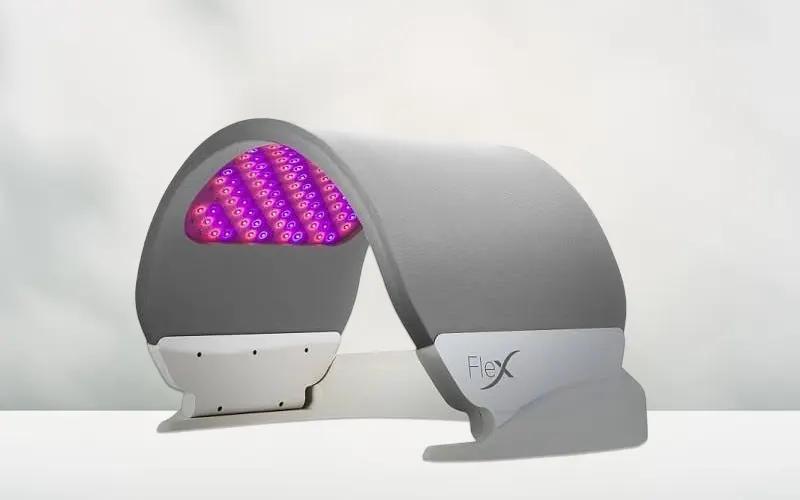
The Dermalux Flex MD was built to close that gap. Dermalux has supplied clinics for years, and this is that technology in a form you keep at home. It runs the three wavelengths with the strongest research behind them: 415nm blue, 633nm red, and 830nm near-infrared.
What sets it apart is the array itself. Rather than a rigid panel, the LEDs are held in a flexible canopy that bends over your face or lies flat against your back, chest, or legs. Pack it into its bag and the whole system travels.
None of that comes cheap, which is the question this review works through. We have gone through the official specifications, independent spectrometer testing, hands-on accounts, and feedback from 320 verified buyers to find out whether the Flex MD earns its price.
How Does it Rate?
Dermalux Flex MD
 4.8/5Quality
 4.7/5User Friendly
 4.2/5Value
 4.6/5Customer Satisfaction
Pros
- Three clinically proven wavelengths
- Class IIA medical device
- Flexible panel fits face or body
- Seven light settings to match your goal
- Light enough to move room to room
Cons
- Lower irradiance than professional clinic systems
- Available through online retailers
Dermalux Flex MD at a Glance
| Device Type | Flexible LED light therapy system |
|---|---|
| Wavelengths | 415nm, 633nm, 830nm (+/- 2nm) |
| LEDs | 360 |
| Intensity | 5 to 27mW |
| Treatment Time | 1 to 30 minutes |
| Light Modes | Blue, red, near-infrared and combinations |
| Device Classification | Class IIA Medical Device |
| Treatment Areas | Face and body |
| Warranty | 2 years |
| Weight | 3.31 lb (excluding packaging) |
| Best For | Skin rejuvenation, blemishes, redness and targeted body treatments |
| Current Price | $2,569.99 |
| Purchase | Official website |
How Does the Dermalux Flex MD Work? & Scientific Evidence
Light therapy starts with something your cells already do. Every cell contains tiny structures that generate its power, and those structures happen to absorb light at particular wavelengths. When light of the right color reaches them, they produce more of the fuel the cell runs on, and a cell with more fuel repairs itself faster and works more efficiently. In skin, that shows up as better collagen production and quicker healing.
The proper name for this is photobiomodulation. Nothing happens overnight, though, because the process depends on repetition. Results build across a few weeks of regular sessions.
That effect depends heavily on which color of light reaches which layer of skin, and this is where the Flex MD separates itself from simpler devices. It runs three:
- Blue (415nm): works right at the surface of your skin. That is where the bacteria behind breakouts live, which is why blue is the color used for acne. A study of 107 people found it clears blemishes faster when combined with red, and that combination is one of the settings on this device.
- Red (633nm): reaches the layer underneath, where your skin makes collagen and elastin. These are what keep skin firm and smooth, so red is the color most studied for fine lines and texture.
- Near-infrared (830nm): goes deeper than the other two, past the skin itself. A review of the research found it helps skin heal faster after cosmetic treatments by encouraging the repair cells to produce more collagen.
Each of the three has been studied on its own. One trial went further and tested two of them together. Researchers ran a split-face study, treating one side of each person’s face with 633nm and 830nm and leaving the other side untouched. That is the exact combination the Flex MD delivers in its red and near-infrared setting, and the treated side finished with fewer wrinkles, firmer skin and more collagen.
Findings like those come from specific equipment at specific distances, so the sensible way to read them is as an indication of what the wavelengths can do rather than a guarantee of what any one device will deliver.
Key Features of the Dermalux Flex MD
Six things separate this from a standard home LED device, and most of them come down to how it is built rather than what it claims.
Three Clinically Established Wavelengths:
Plenty of devices list impressive wavelength counts. What matters more is precision, and Dermalux builds to a tolerance of plus or minus 2nm.
That accuracy is why independent testing found all three colors landing where the company says they should. You are getting the wavelengths you paid for, not something approximate.
360 LEDs for Broad Light Coverage:
The Flex MD holds 360 bulbs spread evenly across the panel. Even spacing is the point here, because it means light reaches your whole face rather than concentrating in the middle and fading at the edges.
LED count alone never tells you much, since it says nothing about output or wavelength accuracy. Paired with those, though, 360 evenly placed bulbs cover a face comfortably and a body area without repositioning.
Flexible LED Panel:
This is the feature that sets the Flex MD apart from almost everything else at home. Rather than a rigid board, the panel bends.
Curve it over your face and it follows the shape of your head, keeping the light an even distance from your skin. Lay it flat and it rests against a back, a chest, or a leg. Rigid panels cannot do either.
Face and Body Versatility:
Because the panel bends and detaches from its base, one device handles areas most LED products cannot reach.
Faces and necks are the obvious use. The same panel also lies across a décolletage, a back, arms, or legs, which is why several owners mention using it for aches as well as skin.
Multiple Treatment Modes:
You are not locked into one setting. Dermalux gives you five combinations, each matched to a different goal:
- Blue: treats mild to moderate blemishes
- Blue and red: treats blemishes while fading scarring
- Red: reduces fine lines and wrinkles and keeps skin plump
- Red and near-infrared: improves elasticity, texture and smoothness
- Near-infrared: calms irritation and reduces inflammation
Portable Professional-Style Design:
Everything the system needs arrives together: the base unit, the flexible panel, a controller, power supply, goggles, a treatment pillow, and a travel bag.
The bag matters more than it sounds. It means the whole system packs down between sessions rather than living permanently on a table, which is a large part of why clinic-grade equipment works in a home at all.
Hands-On With the Dermalux Flex MD: What Testers Found
Reviewers who spent weeks with the device agree on most of it, and their observations line up closely with what the specifications promise.
Setting Up
Reviewers who unboxed the Flex MD describe a well-packaged system, with the LED panel in its own protected layer and the rest of the kit stored below. Assembly takes a few minutes:
- Slide the panel into the base for facial treatment
- Connect the controller cable
- Plug in the power supply
- Check the user guide and protocols guide, both supplied
Fit and Positioning
The base holds the panel curved above your face like a canopy, which keeps the light an even distance from your skin. Dermalux recommends around one inch, and the supplied pillow is designed to set that gap for you.
For body treatment the panel lifts off the base entirely and lies flat against whatever you are treating. One reviewer described running sessions on a bed and taking the panel on and off easily, since the components are light.
Light Intensity
All three colors together produce a pink glow that testers found bright but comfortable to lie under with the goggles on. Blue and red are both clearly visible.
Near-infrared is invisible to the eye, so the panel can look switched off while it is running. That surprises most people the first time.
Comfort Over 20 to 30 Minutes
Sessions run up to 30 minutes, and testers agree that staying still for that long takes a little planning. One treats it as time to relax with a podcast, another runs it first thing in the morning.
The pillow supports your head and neck throughout. One verified buyer found it firm and swapped in her own, which Dermalux accepted as fine provided the one-inch distance is kept.
Controls
The controller carries seven pre-programmed treatments. You choose one, set the duration, and press start. A built-in timer runs the session and ends it, so there is no clock-watching.
Hands-On Takeaway
What testers consistently praise:
- Feels like clinic equipment rather than a consumer gadget
- Specifications hold up when measured
- Flexible panel positions easily on face or body
- Controls are simple to learn
Practical points worth knowing:
- Needs a flat surface and some space
- You stay in position for the session
- A considered purchase at this price
Dermalux Flex MD Benefits
Three wavelengths and five settings means one device covers a lot of ground, so here is what each combination is actually for.
Supports Skin Rejuvenation
Red and near-infrared together is the setting Dermalux recommends for firmness and texture, and it is the pairing with the most evidence behind it.
A trial of 137 women aged 40 to 65 ran ten sessions across four weeks and measured a roughly 30% reduction in wrinkle volume around the eyes. [3]
Helps Improve the Appearance of Redness
Near-infrared on its own is the calming setting. Dermalux positions it for reducing inflammation and soothing irritation rather than for visible anti-ageing work.
Several verified buyers mention using it for exactly that, including one who reported her skin settling noticeably after around five weeks of near-daily sessions.
Supports Blemish-Prone Skin
Blue light is the acne setting, and it works by going after the bacteria involved in breakouts rather than by energizing cells the way red does.
Blue and red together is the option Dermalux suggests when scarring is also a concern, since red addresses the marks left behind while blue handles what caused them.
Supports Skin Recovery
Red and near-infrared are widely used after cosmetic procedures, which is why clinics run LED sessions following treatments like laser work.
One long-term owner described using hers after abrasive facial treatments to speed things along, alongside cuts, bruises and muscle strains.
Treat More Than Just the Face
The flexible panel lifts off its base and lies flat, which opens up areas most LED devices simply cannot reach: neck, décolletage, chest, back, arms and legs.
That versatility is a large part of what justifies the price, since you are not buying a second device later.
Professional-Style Treatment at Home
Class IIA certification, clinic-grade construction and five customizable settings put the Flex MD in a different category from a consumer mask.
A split-face study on the same wavelengths this device uses recorded more collagen and better elasticity on the treated side.
Dermalux Flex MD vs. Other LED Light Therapy Devices
Most people shopping at this level are weighing three very different things, so it helps to see them side by side.
| Feature | Dermalux Flex MD | Typical LED Mask | High-Powered RLT Panel |
|---|---|---|---|
| Face treatment | Yes | Yes | Yes |
| Body treatment | Yes | Limited | Yes |
| Flexible panel | Yes | Depends on device | Usually no |
| Blue light | Yes | Some | Some |
| Red light | Yes | Yes | Yes |
| Near-infrared | Yes | Some | Yes |
| Treatment customisation | Yes | Varies | Varies |
| Portability | Good | Excellent | Lower |
| Professional positioning | Strong | Consumer | Varies |
Each of these makes sense for someone. A good LED mask is affordable and covers facial skincare well. A high-powered panel puts out far more light and treats large areas, which is what you want for muscles and joints.
Read down the columns, though, and only one has no gaps in it. That is what the price buys: not a better mask or a smaller panel, but the option where you are not choosing which compromise to accept.
Who Is the Dermalux Flex MD Best For?
At this price the honest answer is that it suits some people extremely well and others not at all.
Best for:
- Long-term LED users: anyone already committed to light therapy who wants equipment that will still be right in five years
- Face and body treatment: people who want one device covering skin and aches rather than two
- Multiple wavelength combinations: users who want to match the light to the concern instead of running one fixed setting
- Buyers who want a system, not a mask: a base, a controller, and clinic-grade construction rather than a wearable
- People treating different areas regularly: a face one week, a shoulder the next, a back after that
- Anyone replacing clinic visits: the maths changes considerably if you have been paying per session
May not be ideal for:
- Tight budgets: at $2,569.99 this is a considered purchase, and it makes most sense once you know light therapy suits you
- Facial skincare only: if skin is your single focus, much of what this device offers goes unused
- Wearable treatment: you lie under this one, which some people prefer and others do not
- Deep tissue work: dedicated full-body panels are built for muscles and joints, whereas this is built for skin
- Limited space: the base and panel work best with a flat surface and a little room
Dermalux Flex MD Reviews: What Users Say
CurrentBody currently shows 320 reviews at an average of 4.9 out of 5, with 99% of buyers saying they would recommend it.
Positive Experiences
The most common theme is skin appearance. Buyers describe firmer, plumper skin, brighter complexion, and reduced redness, with several noting improvement in texture within the first month.
Blemish improvement comes up regularly too, as does wound healing. One buyer reported using it after laser treatment because it helped her skin recover faster.
The other recurring theme is how easily it fits into a routine. Buyers describe sessions as genuinely relaxing rather than a chore, several using the time to listen to a podcast or audiobook.
Mixed Experiences
The most consistent practical note concerns the treatment pillow. One buyer found it too firm for her neck and substituted her own, which CurrentBody confirmed is fine as long as the recommended distance from the panel is maintained.
Session length is the other recurring point. Thirty minutes is a long time to stay still, and buyers who succeed with it tend to build it around something they were doing anyway.
Long-Term Users
This is where the feedback gets genuinely useful. One buyer returned after three to four years of ownership to say she still uses it three or four times weekly and considers it part of her health routine.
Another has used hers almost daily for two years. A third had a fault develop just before her warranty expired and reported that CurrentBody replaced the unit immediately.
How to Use the Dermalux Flex MD
Dermalux keeps the process simple, and the supplied protocol guide covers the details.
Getting set up
- Slide the panel into its base, connect the controller, plug in the power supply
- Cleanse your skin first, since makeup, sunscreen, or heavy product will block the light
- Lie down with the panel curved above you, roughly one inch from your skin. The supplied pillow sets that distance for you
- Put on the goggles
Running the session
- Choose one of the seven pre-programmed treatments based on what you are working on
- Set your session length, anywhere from 1 to 30 minutes
- Relax and let the timer handle it. Most buyers use the time for a podcast or music
Afterwards
- Apply serums and moisturisers once the session ends, when your skin is ready to take them in
Sessions can be run daily, and consistency matters more than length.
Is the Dermalux Flex MD Safe?
LED light therapy is generally well tolerated, and the Flex MD’s Class IIA certification means it has been assessed against medical device standards rather than consumer ones.
Goggles come in the box and are worth wearing every session. The light is bright, particularly with blue running, so eye protection is a sensible habit rather than something to skip.
Dermalux does list situations where the device should not be used, and it is worth checking this before you buy:
- Pregnancy or breastfeeding
- Lupus, photosensitive eczema, or albinism
- Any condition causing sensitivity to light
- Headaches triggered by light
- Genetic eye conditions
- Medication that increases light sensitivity, including some antibiotics, chemotherapy drugs, and diuretics
- St John’s Wort or coal tar preparations
Certification tells you the device is well made and properly tested. Whether it is right for you is a separate question. If any of the above applies, or you are treating a skin condition, have a word with your doctor before starting.
Price, Warranty & What’s Included
The Dermalux Flex MD sells for $2,569.99, comes with a two-year warranty, and is HSA and FSA eligible.
Everything arrives in one box:
- Dermalux Flex MD base unit
- Dermalux Flex MD controller
- Flexible LED canopy
- Power supply with 1.5m lead
- Treatment pillow
- Goggles
- Travel bag
- User manual
The price is easier to judge once you know how long the device lasts. Reviews regularly come from buyers still using theirs after two, three, and four years, and one owner had a fault replaced under warranty without any trouble. Over that many years, it works out to a modest cost per year.
The HSA and FSA eligibility is worth noting as well. If you have funds in either account, the effective cost drops without any discount being applied.
Frequently Asked Questions
How long do you use the Dermalux Flex MD for?
A: Sessions run from 1 to 30 minutes, and it can be used daily. Most buyers settle around 20 to 30 minutes, three to five times a week, which is where the reviews suggest results build.
Is Dermalux Flex MD FDA approved?
A: It is certified as a Class IIA Medical Device, which is a European and UK classification rather than an FDA one. The FDA does not “approve” devices in this category at all; it clears them through a separate process. If US regulatory status matters to you, check the current position with the retailer before buying.
Can you use the Dermalux Flex MD every day?
A: Yes. Daily use is within the manufacturer’s guidance, and several long-term owners report using it three to five times weekly for years.
What is the difference between Dermalux Flex MD and Dermalux clinic devices?
A: Same wavelengths, same core technology. The Flex MD is designed for home use, so treatments happen on your schedule rather than around appointment availability.
Does the Dermalux Flex MD help with wrinkles?
A: Red and near-infrared are the wavelengths most studied for fine lines and skin firmness, and the Flex MD runs both. Results build over weeks rather than days, and vary between people.
Is the Dermalux Flex MD worth the price?
A: It depends on how much you will use it. For someone treating both face and body regularly, or already paying for clinic sessions, the case is stronger than the headline figure suggests.
Do you need to wear goggles?
A: Goggles come in the box and are worth wearing every session, particularly with blue light running.
Final Verdict
The Flex MD does something very few home devices manage: it treats your face and your body properly, using the same technology Dermalux supplies to professional clinics. The bending canopy is what makes that possible, curving over a face one day and lying flat across a back the next. Behind it are three clinically established wavelengths and five combinations to choose from, and when an independent reviewer measured the device with a spectrometer, all three landed exactly where Dermalux says they should.
At $2,569.99, it is a considered purchase, and it rewards regular use across both face and body. Sessions run up to 30 minutes with you staying in position throughout, so it works best when built into a routine rather than squeezed in, and you will want a flat surface with a little room to set it up.
If you are committed to light therapy and want one device covering skin and body without compromise, the Flex MD earns its place. Plenty of owners are still using theirs three and four years on, which says something about how well it lasts.




September 30, 2026
A BIG step up from my old LED mask for overall versatility
I’ve tried smaller LED masks before, but the Flex MD feels much more versatile. Being able to treat my face one day and my back or legs another day is useful. The improvements have been gradual, and I think consistency makes the biggest difference. It’s not something I’d buy casually because of the price, but I’m satisfied with it.
September 14, 2026
It took patience, but I’m glad I kept using it
It has become one of the few skincare devices I’ve actually managed to use consistently. I like having red, blue, and near-infrared wavelengths in one panel, and the flexible shape makes it useful for different areas. The improvements have taken time, so I wouldn’t recommend it to someone expecting instant results. For regular home use, though, I’m very happy with it.
September 10, 2026
Finally, an LED device I can use on my face AND body
I bought the Dermalux Flex MD mainly because I wanted something I could use on more than just my face. The flexible design makes it easy to position around my shoulders and legs as well. After using it consistently for several weeks, my skin looks a little more even and my muscles feel more relaxed after sessions. The results are gradual, but I’m happy with it overall.