

 Fact Checked

Overview
Red light therapy has moved well beyond small handheld devices. Today, larger panels make it possible to treat the back, legs, upper body, and other broad areas without constantly moving the light around.
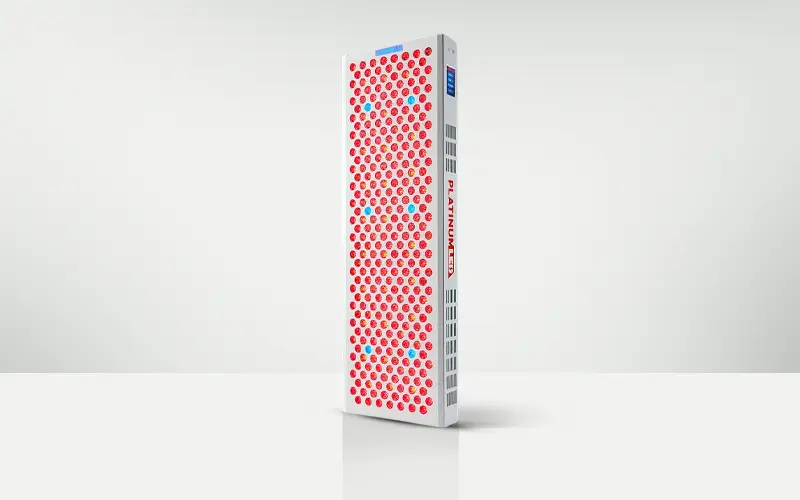
The PlatinumLED BIOMAX 900 is built for exactly that kind of use. It is the largest panel in the standard BIOMAX range, with 300 LEDs, seven wavelengths, separate red and near-infrared controls, strong light output, and support for multi-panel setups.
It is clearly a premium product. The panel is large, heavy, and more expensive than entry-level options. A dedicated stand also costs extra. Still, its coverage, controls, build quality, and expandability make it an appealing choice for people who expect to use red light therapy regularly.
In this PlatinumLED BIOMAX 900 review, we look at its features, performance, benefits, safety, customer feedback, and overall value.
What Is the PlatinumLED BIOMAX 900?
The PlatinumLED BIOMAX 900 is a large red and near-infrared light therapy panel made for broader treatment areas and home full-body sessions.
It measures about 36 x 12 x 3 inches, weighs 33 pounds, and contains 300 LEDs. Rather than relying on just one red and one near-infrared wavelength, it combines seven wavelengths ranging from blue light at 480 nm to near-infrared light at 1060 nm.
Its size is one of its biggest advantages. Small panels work well when you only want to focus on a knee, shoulder, or face. With the BIOMAX 900, you can expose much larger areas such as your back, thighs, or upper body during one session.
The panel is also modular. If one BIOMAX 900 is not enough, additional panels can be connected later to create a larger full-body setup.
PlatinumLED BIOMAX 900 Review: How Does It Rate?
PlatinumLED BIOMAX 900
 4.9/5Quality
 4.8/5User Friendly
 4.5/5Value
 4.8/5Customer Satisfaction
Pros
- Seven wavelengths
- 300 LEDs
- Large treatment area
- Strong light output
- Separate red and NIR controls
- Adjustable brightness
- Blue light can be turned off
- Remote and app control
- Expandable multi-panel design
- 100,000-hour rated LED lifespan
Cons
- Weighs 33 pounds
- Not especially portable
- May be excessive for users treating only small areas
- Larger setups require space
About PlatinumLED – The Manufacturer
PlatinumLED has been involved in the red light therapy space since 2010. Rather than selling a wide mix of unrelated wellness products, the company focuses heavily on red and near-infrared light technology.
Its current lineup includes BIOMAX, BIOMAX PRO, portable light devices, sauna-focused products, multi-panel setups, and several mounting systems.
That established product range is useful for long-term buyers. You can start with one panel and later add compatible stands, mounting systems, remotes, or additional panels without rebuilding your setup from scratch.
PlatinumLED also backs the BIOMAX range with a three-year warranty.
PlatinumLED Brand Highlights
- In the red light therapy market since 2010
- Broad range of red and NIR devices
- Third-party light-output testing
- Three-year BIOMAX warranty
- International availability
- Home and professional setups available
Key Features That Make the BIOMAX 900 Stand Out
7-Wavelength Spectral Output
The wavelength selection is one of the BIOMAX 900’s strongest features.
It uses:
- 480 nm blue
- 630 nm red
- 660 nm red
- 810 nm near-infrared
- 830 nm near-infrared
- 850 nm near-infrared
- 1060 nm near-infrared
The benefit is not simply having a bigger number of wavelengths. Red light is generally associated with more surface-level exposure, while near-infrared wavelengths can reach farther into tissue.
Using several wavelengths allows the BIOMAX 900 to provide a broader range of light during the same session.
Importantly, you do not need to run seven separate sessions. The wavelengths are designed to work together, while the red and NIR groups can still be adjusted independently.
Large Full-Body Coverage
With 300 LEDs across a 36-inch-tall panel, the BIOMAX 900 is built for much more than spot treatment.
A single panel will not literally expose every inch of an adult body at once, especially front and back. But it can cover a substantial section of the body during each session.
That reduces how often you need to stop, move the panel, and start again.
For someone using red light three or four times each week, that convenience becomes important. A routine that takes 15 or 20 minutes is much easier to maintain than one involving several smaller treatment zones.
Adjustable Controls and App Support
The BIOMAX 900 gives you separate control over its red and near-infrared arrays.
Both can be adjusted from low to full output, while the 480 nm blue LEDs can be controlled separately.
This gives you more flexibility than a simple panel with one power button.
You might prefer stronger combined red and NIR exposure for your legs after exercise but lower the intensity when using the light closer to your face.
A remote is included, and app control adds another convenient way to manage sessions.
Strong Light Output
The BIOMAX series is known for high output, and the 900 is designed to deliver strong light across a relatively large treatment area.
In practical terms, this means you do not have to stand extremely close to the LEDs just to receive useful exposure.
That makes sessions more comfortable and gives you more freedom when positioning yourself.
However, stronger output does not mean longer sessions are always better. Red light therapy is still about using a sensible combination of intensity, distance, and time.
Modular Expansion
The BIOMAX 900 does not have to remain a single-panel setup.
Additional BIOMAX units can be connected to create a larger system. This can be particularly useful for dedicated home wellness spaces, gyms, or professional environments.
You could start with one panel and decide later whether the extra coverage is worth the additional investment.
That makes the system more flexible than buying one oversized device with no room to expand.
Multiple Mounting Options
PlatinumLED offers several ways to position the BIOMAX panels, including wall mounts, mobile floor stands, horizontal stands, rack systems, and motorized options.
A wall-mounted setup is useful if the panel will stay in one place. A mobile stand offers more freedom to change position or angle.
Horizontal mounting can be especially appealing if you prefer lying down during sessions.
The downside is that a dedicated stand is not included in the standard panel price, so it should be considered when budgeting for your setup.
First-Hand Testing Experience – What It Was Like Using the BIOMAX 900
Initial Unboxing
The first thing I noticed was that this is not a lightweight wellness gadget.
At 33 pounds, the BIOMAX 900 feels substantial before it is even mounted. I would definitely decide where you want to use it before unpacking everything.
The package includes the light panel, eye protection, remote control, power cable, patch cable, hanging brackets, a door hook, wrench, screws, and other mounting hardware.
There is enough included to get a basic hanging setup started.
What you do not get is a full floor or horizontal stand. If that is how you plan to use the panel, it is worth ordering the mounting system at the same time.
First Impressions
The BIOMAX 900 has the solid feel you would expect from a premium panel.
The metal body feels sturdy, the overall finish is clean, and the panel does not give the impression of being a lightweight consumer gadget.
Its size also stands out immediately.
Thirty-six inches may not sound huge on a specification sheet, but once the BIOMAX 900 is in a bedroom or home gym, it takes up a noticeable amount of space.
For me, that feels like a fair tradeoff for the extra treatment coverage.
Daily Use Experience
Once the panel is mounted, using it becomes very straightforward.
I liked having separate control over the red and near-infrared light instead of being forced to run everything at exactly the same level.
The timer also makes sessions easy to manage. You can set the treatment time, start the panel, and focus on something else instead of watching the clock.
Brightness is intense at higher settings. For face-forward sessions, the supplied eye protection makes the experience more comfortable.
The cooling fans create some background noise, but it is not enough to make listening to music or a podcast difficult.
There is also some warmth during use. I noticed it more during longer sessions or when standing closer to the panel, but it does not feel like the intense heat you would get from a sauna.
Practical Observations
The biggest improvement over smaller panels is simply how much less repositioning is required.
With a compact panel, treating your upper back, lower back, shoulders, and legs can turn into several separate sessions.
The BIOMAX 900 makes larger-area routines much easier.
It also fits naturally into a post-workout routine. After training, you can stand in front of the panel, start a timed session, and be finished without moving a smaller device repeatedly.
That convenience is probably one of the strongest arguments for choosing the BIOMAX 900 over a smaller model.
Features & Quick Specs
- Best For: Full-body and large-area red light therapy
- Overall Rating: 4.7/5
- Price: $659
- Standout Feature: Seven-wavelength output with separate red/NIR controls
- Warranty: 3 years
- Ideal Buyer: Athletes, wellness users, and people upgrading from smaller panels
| Specification | BIOMAX 900 |
|---|---|
| LEDs | 300 |
| Wavelengths | 480, 630, 660, 810, 830, 850, 1060 nm |
| Dimensions | 36 x 12 x 3 inches |
| Weight | 33 lb |
| Power Consumption | 380W/490W |
| Rated Lifespan | 100,000 hours |
| Warranty | 3 years |
| EMF | Manufacturer lists 0.0 µT at 4 inches |
| Best For | Large-area and full-body use |
Health Benefits of the PlatinumLED BIOMAX 900
The BIOMAX 900 uses wavelengths commonly found in photobiomodulation research. That does not mean the finished panel has been clinically proven for every benefit below, but its red and NIR wavelengths are relevant to several well-studied areas.
Muscle Recovery
Red and near-infrared light have been studied before and after exercise.
Some research suggests photobiomodulation may help support muscle recovery, reduce post-exercise soreness, and help muscles return to normal performance after demanding activity.
The BIOMAX 900 is particularly convenient here because it can expose large muscle groups rather than one small spot at a time.
Joint Comfort
Photobiomodulation has also been researched for joint discomfort.
A 2026 study reported improvements in pain-related measures, although results differ between conditions and study designs.
It is reasonable to view red light as something that may support joint comfort, rather than a replacement for medical treatment.
Exercise Recovery
For athletes, the combination of strong output and large coverage may be more useful than any single wavelength.
Research has explored PBM for soreness, muscle damage, recovery, and exercise performance. Results depend on the dose, wavelength, timing, and type of activity.
This makes consistent, sensible use more important than simply turning the panel to maximum power.
Skin Rejuvenation
Red wavelengths around 630 and 660 nm have been widely studied in skincare.
Research has looked at changes in skin texture, collagen-related activity, fine lines, and wrinkle appearance.
Since the BIOMAX 900 includes both 630 and 660 nm, it can also be used for skin-focused sessions when positioned at an appropriate distance.
Sleep and Everyday Wellness
Near-infrared photobiomodulation is also being explored in sleep-related research.
The BIOMAX 900 should not be viewed as a treatment for insomnia. It may simply fit into a wider wellness routine alongside exercise, good sleep habits, and stress management.
Inflammation Support
Red and near-infrared light may influence some of the pathways involved in the body’s normal inflammatory and recovery responses.
For general wellness, it is more appropriate to say PBM may help support normal recovery processes.
Cellular Energy
One of the main theories behind photobiomodulation involves mitochondria, the structures cells use to produce energy.
Research suggests certain red and near-infrared wavelengths may influence mitochondrial activity and pathways linked with cellular energy production.
This is one reason PBM is being studied across such a wide range of wellness and recovery areas.
How the 7-Wavelength System Works
Each wavelength in the BIOMAX 900 has slightly different properties.
630 nm and 660 nm are visible red wavelengths commonly studied for skin and surface-level applications.
810 nm, 830 nm, and 850 nm are near-infrared wavelengths. They are invisible to the eye and are frequently used in research involving muscles, recovery, joints, and deeper tissues.
1060 nm extends farther into the near-infrared range and gives the BIOMAX 900 a broader spectrum than many two-wavelength panels.
Finally, 480 nm blue light is more surface-focused and is mainly associated with skin applications.
The good part is that users do not need to understand every wavelength before using the panel. For most general sessions, the system can run several wavelengths together.
Scientific Evidence Behind the Wavelengths
The science behind photobiomodulation is broader than research on any one consumer panel.
Clinical studies using 630 and 660 nm red light have reported improvements in some skin measurements, including fine lines and wrinkle appearance.
Near-infrared wavelengths such as 810, 830, and 850 nm have been studied in areas including exercise recovery, muscle performance, pain, tissue response, and cellular activity.
Research involving wavelengths around 1060 to 1064 nm has also looked at mitochondrial activity, oxygen use, and other biological responses.
Blue light has its own research base, particularly in skin-related applications.
These studies help explain why the wavelengths found in the BIOMAX 900 are interesting. However, research results cannot simply be transferred from one device to another. Clinical studies use specific doses, treatment times, distances, and light sources.
The evidence supports the broader science of red and near-infrared light therapy rather than guaranteeing a particular result from the BIOMAX 900.
How to Use the PlatinumLED BIOMAX 900
PlatinumLED recommends relatively simple general-use guidelines.
Sessions are typically around 10–20 minutes per treatment area.
For deeper areas, the suggested distance is approximately 8–14 inches from the skin. For facial or surface-level use, the recommendation increases to about 16–24 inches.
The manufacturer generally suggests using red light therapy 3–5 times per week.
Sessions should be performed on bare skin where possible, since clothing can block some of the light.
You also do not need a separate session for every wavelength. Red and NIR can be used together, while their intensity can be adjusted separately.
If you are new to red light therapy, start with a shorter session or greater distance. You can then adjust gradually as you become familiar with the light.
For broader use, face the panel during part of your session and turn around when you want to expose the back of the body.
Safety, Side Effects and Precautions
The BIOMAX 900 is easy to use, but its strong light output still deserves sensible precautions.
- Eye protection: The panel includes eye protection. Avoid staring directly into the LEDs, particularly at high brightness.
- Photosensitive medications: Certain medicines can increase sensitivity to light. Speak with your healthcare provider if you take a photosensitizing medication.
- Pregnancy: Research during pregnancy is limited, so medical advice is recommended before use.
- Heat: Mild warmth may occur during a session. If the skin becomes very hot, painful, or irritated, stop and increase your distance or shorten the next session.
- Dosing: Longer and stronger is not always better. Follow recommended session lengths and gradually find a comfortable routine.
People with medical conditions, eye concerns, unusual skin sensitivity, or ongoing unexplained pain should talk to a healthcare professional before using the panel.
Is the PlatinumLED BIOMAX 900 Worth the Price?
The BIOMAX 900 sits firmly in the premium category, so its value depends on how seriously you plan to use it.
For someone simply curious about red light therapy, a smaller panel is probably the more sensible starting point.
Regular users get more from the BIOMAX 900.
You are paying for 300 LEDs, seven wavelengths, large-area coverage, strong output, independent red and NIR controls, a long rated lifespan, a three-year warranty, and the ability to expand the system later.
The panel’s size can also save time if you would otherwise need several positions with a smaller device.
The stand being sold separately is the main drawback. Once a premium mounting system is added, the total investment rises.
Still, if the panel becomes something you use three to five times every week, its convenience and larger coverage can make the higher upfront price easier to justify.
PlatinumLED BIOMAX 900 Customer Reviews
Customer feedback around the BIOMAX range is largely positive.
Build quality is one of the most common themes. Owners frequently describe the panels as sturdy and substantial, which fits with the BIOMAX 900’s 33-pound construction.
Customers also commonly mention recovery and comfort. Some buyers say they use their panels after workouts or on areas that regularly feel stiff or sore.
Skin-focused use appears regularly in feedback too, with customers adding the panel to their general skincare and wellness routines.
Ease of use is another positive point. Once everything is mounted, there is not much work involved. Choose your settings, set the timer, and start the session.
The main criticisms are practical. The BIOMAX 900 is heavy, a full stand costs extra, and the total setup can become expensive when premium mounting equipment is added.
Those who only want to treat a knee, shoulder, or small area may also find the 900 unnecessarily large.
A user shared her experience with Platinum Red Light Therapy on Reddit, she had long battled stubborn facial hyperpigmentation, trying a multitude of remedies from drugstore creams to pricey facials without success. Frustrated and desperate, she decided to explore red light therapy as a last resort.
She invested in a PlatinumLED red light therapy device and began using it daily for just 10 minutes. To her amazement, within a few weeks, she began to witness a transformation. The hyperpigmentation that had plagued her for years was visibly fading, leaving her with brighter and more even-toned skin.
A month into her red light therapy journey, She was astounded by the remarkable difference. Her hyperpigmentation was nearly gone, and her skin radiated with newfound health. So delighted with her results, she took to Reddit to share her story, inspiring others grappling with hyperpigmentation to consider red light therapy.
Her tale showcases the potential of red light therapy in improving skin health. This safe and effective treatment has demonstrated effectiveness in reducing hyperpigmentation, wrinkles, fine lines, and acne while enhancing skin tone and texture. If you’re facing skin challenges, red light therapy could be a valuable solution with a significant impact on your skin’s appearance.

Who Should Buy the BIOMAX 900?
The BIOMAX 900 is best suited to:
Athletes and active users who want large-area sessions after training.
Regular gym-goers looking to build red light therapy into their recovery routine.
Wellness enthusiasts creating a dedicated home setup.
People wanting full-body exposure rather than repeatedly moving a small panel.
Experienced red light users who are ready to upgrade from a smaller device.
People interested in red light therapy for ongoing pain or a medical condition should still discuss their symptoms with a healthcare professional. The BIOMAX 900 is not a replacement for medical care.
Frequently Asked Questions
Is the BIOMAX 900 suitable for full-body treatments?
A: Yes. It is designed for large-area and full-body use. You will still normally turn or reposition yourself to expose both the front and back of your body.
Does the BIOMAX 900 include 1060 nm?
A: Yes. Its seven wavelengths are 480, 630, 660, 810, 830, 850, and 1060 nm.
Can red and NIR be controlled separately?
A: Yes. Red and near-infrared intensity can be adjusted separately, while blue light has its own control.
Can several BIOMAX panels be connected?
A: Yes. The modular design allows multiple BIOMAX panels to be combined into larger setups.
Does it include a stand?
A: A dedicated floor or horizontal stand is not included with the standard panel. Compatible mounting systems are available separately.
How long should sessions last?
A: The general recommendation is around 10–20 minutes per treatment area, with beginners starting more gradually.
Can I use the BIOMAX 900 every day?
A: Some users may tolerate frequent use, but the manufacturer’s general recommendation is around 3–5 sessions per week.
What warranty does it have?
A: The BIOMAX 900 comes with a three-year warranty.
Final Verdict – Is the PlatinumLED BIOMAX 900 Worth Buying?
The PlatinumLED BIOMAX 900 is a well-built, powerful option for people who want to take full-body red light therapy seriously.
Its strongest points are the seven-wavelength system, 300 LEDs, large treatment area, separate red and NIR controls, strong output, modular design, and three-year warranty. It is also much more convenient than repeatedly moving a small panel around the body.
There are a few tradeoffs. It is expensive, weighs 33 pounds, and a dedicated stand adds to the cost.
For occasional or small-area use, a smaller device will probably make more sense. But for athletes, wellness-focused users, and anyone planning regular large-area sessions, the BIOMAX 900 offers a strong mix of performance, flexibility, and long-term usability.






Rating Snapshot:
Review this product & share your experiences with other customers. Don't see your question? Ask away!
Add a YouTube video